
JIM JAM JEMS BY JIM JAM JUNIOR
Jim Jam Jems. Bismarck, North Dakota, February 1914, v. 3, pp. 24-29 : Clark and Crockard [Link to HathiTrust].
Jim Jam Jems was an independent, muckraking magazine published from Bismarck, North Dakota, beginning in 1912 and continuing into the late 1920s. Created and largely written by Sam H. Clark under the pen name “Jim Jam Junior,” with Clarence H. Crockard as co-publisher, it presented itself as a blunt, truth-telling journal with a flair for sensationalism. Each issue was a small booklet, typically around sixty pages, and sold for twenty-five cents. Its content mixed exposés, moral and social commentary, satire, political criticism, and vivid human-interest narratives. The magazine frequently tackled topics considered taboo at the time: prostitution, “white slavery,” corruption, medical abuses, wartime politics, and perceived moral decline. Its voice was deliberately provocative, aiming to jolt the reader rather than maintain journalistic decorum.
The magazine quickly attracted national attention, not only for its content but also for the legal battles it provoked. Federal authorities prosecuted Clark and Crockard under obscenity laws for transporting allegedly indecent material through the mail. Although they were initially acquitted on some charges, they were later convicted, fined, and sentenced to federal prison. Despite these setbacks, Jim Jam Jems continued to publish for many years, becoming both notorious and influential in the Upper Midwest. Historians view it today as an unusual blend of investigative zeal, moral crusading, and pulp-style sensationalism, offering a vivid window into the anxieties, reform impulses, and contradictions of early twentieth-century American culture.
NO PRIMROSE PATH
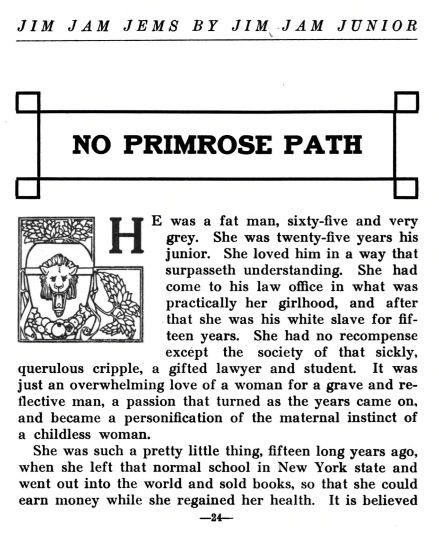
He was a fat man, sixty-five and very grey. She was twenty-five years his junior. She loved him in a way that surpasseth understanding. She had come to his law office in what was practically her girlhood, and after that she was his white slave for fifteen years. She had no recompense except the society of that sickly, querulous cripple, a gifted lawyer and student. It was just an overwhelming love of a woman for a grave and reflective man, a passion that turned as the years came on, and became a personification of the maternal instinct of a childless woman.
She was such a pretty little thing, fifteen long years ago, when she left that normal school in New York state and went out into the world and sold books so that she could earn money while she regained her health. It is believed that until she went to that little New York town, her life had been pure and sweet. Men who saw her and knew of her said that she was beautiful and that she was gifted in many ways. Her mental charm was equal to her physical perfection, and as she demurely explained the merits of the book she sold she was much admired.
Melvin H. Couch was fifty when twenty-four year old Adelaide Brance went into his dingy office in the old Masonic block in Monticello. She spoke to the busy lawyer and he turned his massive head and looked at her. She gave a little gasp and took a step toward him. He reached out and took her hand and smiled. Desire for this beautiful girl suffused him. The yearning to be owned by him was overpowering her. When the cold and wrinkled hands of the lawyer touched the fingers of that sweet girl there was a message went from one to the other. Before the shadows lengthened that day the beautiful girl had given herself to the man, and there was a fire of passion started which burned night and day in her heart through the years and years which followed.
She stayed in Monticello and she went to the law office until people talked about her. Then she went away. One night she came back. She made her way through the silent streets alone. She reached the old Masonic Temple. She went up the stairs. And she took up her abode in a little room that adjoined the office of the man she loved. For twelve years she made it her haven. She came and went in the dark. No one in Monticello knew that she was there, no one but Mel Couch.
One night when she had gone to Cooperstown the Masonic Temple burned. No insurance was collected upon the books and the clothing of Adelaide Brance. No one knew that they were burned except Mel Couch. And he would not tell. She did not get any more nice clothes after that. She did not find her pretty little toilet articles replaced. The recipient of all that the girl could give rented another office and provided a still smaller room adjacent, a domicile with only one window and that closely screened. The girl came back from Cooperstown and took her place in the little back room. There was a cheap iron bedstead, one chair, an oil stove and a few kitchen pieces. And for three years Adelaide Brance remained in that room, with only two absences. One night she went to another town so that she might just look upon other womanhood but not to converse. Another night she slipped out and down a side street and went to the home of her idol and looked through the window and saw him sitting at dinner with his family.
All that she asked was that this old man with the gangrened foot should come into that little bare room which was her castle and permit her to bathe the festering sore, to allow her to minister to his comfort or to yield to his desire. She asked nothing more. The clothing she had worn from Cooperstown after the fire had worn to shreds. He got her a piece of cheap calico and she fashioned a wrapper from it with her needle and thread. And that was what she wore while she thought she was the queen of the aged man's heart.
It was just before Christmas. The holiday spirit was rife in Monticello. The windows were ablaze with decorations. The woman who had given herself to Mel Couch in her beautiful girlhood had drifted into an aged and haggard woman of slow mental processes. The girl who had gone into that prison as a brilliant student of French and English literature had grown sodden in thought as well as action. She had one religion, one God, and that was Mel Couch, the fat old cripple who took her richest treasure in the long ago and found satisfaction in her happiness with her voluntary imprisonment.
The glimmering of old ambition was coming back. The desire to see and to know cultured people, to dress prettily and to build up her faded physical charms began to flicker once more. She suggested to Mel Couch that she go away for just a week. And he burst forth in anger. He needed her to help him with his correspondence. He needed her to help him in other ways, he said. His fury increased until he dropped upon the bed. The distracted and uncouth woman rushed for a doctor. The physician came and found Mel Couch dead. His last word had been to his white slave.
No one knew about her in Monticello. Many recalled the pretty little book agent who had been infatuated with Mel Couch fifteen years before. But no one had ever seen this woman, they said. She told them all. She showed them the room. She proved what her love had amounted to. And they searched her. They found three one dollar bills. She said that Mel had given them to her. And they arrested her for petit larceny.
When the hearse carrying all that was mortal of Mel Couch passed out along the snowy road toward the cemetery, when the half dozen cabs plodded along the slushy highway, the pretty little book agent looked through the iron bars of the jail and as the hearse dipped over a hill and out of sight she cried, "Mel, I will join you soon!"
She is free now. The prosecution for petit larceny did not amount to anything. She went away in an automobile and she is in a sanitarium, hidden from sight.
Perhaps the old mentality will come back to her, the fine intellect which won her honors at the normal school. Perhaps she may bring back the roses that glowed in her cheeks the first time she went up the stairway of the old Masonic Temple to Mel Couch's law office. But she will always remain the strongest proof of what a loving woman will do for a selfish and self-seeking man.
There was a grey haired old lady of whom Couch had grown tired, his wife. There was a cultured daughter whose society he did not seek. As the pretty little book agent slipped and slipped on the toboggan that is always greased for a case like this, the aged Lothario found greater comfort in her mental, moral and physical debasement. And when she reached the calico wrapper stage, and there has nearly always been a calico wrapper stage and nearly always will be, she just suited him.
Today we find the usual thing. Friends followed the man to his grave and wept over him. The girl stands practically alone and the hands of most women are turned against her. The Chicago American printed an interview with three women who talked of the terrible story of the man and the woman. Mrs. Grace Wilbur Trout, Miss Harriett Vittum and Miss Julia Sommer, all prominent in Chicago club life, impaled the poor woman with their terms of contempt. They evidently feel sorry for the man in the case. And there you are. They evidently look upon the pretty little book agent as the seducer and the fat old man as the wounded bird.
How this story fit into the editorial scope of Jim Jam Jems...
Sensationalism and "True Crime" Appeal
Jim Jam Jems thrived on scandalous, real-life dramas that blurred the line between journalism and fiction. "No Primrose Path" is framed as a true story (likely embellished or fictionalized) about Adelaide Brance’s exploitation by Melvin H. Couch, a powerful lawyer. This aligns with the magazine’s penchant for:
- Exposés of corrupt authority figures: Lawyers, politicians, and wealthy men were frequent targets, portrayed as predators preying on vulnerable women (e.g., "The Shame of a Great City" in earlier issues).
- Fallen women narratives: Stories of women "ruined" by men were a staple, often framed as cautionary tales. The trope of the "white slave" (a term used here) was common in Progressive Era muckraking, tying into fears of urban vice and male predation.
- Morbid curiosity: The piece’s focus on Adelaide’s physical and mental decline—her "calico wrapper," imprisonment, and final breakdown—mirrors the magazine’s fascination with female suffering as spectacle, akin to later true-crime tabloids.
Gender and Moral Double Standards
The story entitled "No Primrose Path" (February 1913) is a scathing indictment of patriarchal hypocrisy, a recurring theme in Jim Jam Jems.
Key elements:
- The "aged Lothario" trope: Couch is a grotesque figure—fat, crippled, and morally bankrupt—yet society mourns him while shunning Adelaide. This reflects the magazine’s critique of how men’s sins were excused (e.g., "The Hypocrisy of the Pulpit" in 1913, which attacked clergy for sexual misconduct).
- Female victim-blaming: The piece highlights how women like Adelaide were doubly punished—first by their exploiters, then by society. The inclusion of the Chicago women’s contemptuous quotes (e.g., calling her the "seducer") underscores the magazine’s feminist-leaning outrage at such judgments.
- Maternal vs. sexual love: Adelaide’s devotion is framed as a perversion of maternal instinct, a theme Jim Jam Jems often explored in stories about women trapped in abusive or unequal relationships (e.g., "The Wife Who Was a Slave").
Class and Economic Exploitation
The story critiques economic vulnerability as a tool of control:
- Adelaide’s initial poverty (selling books to recover her health) and later destitution (wearing a calico wrapper) reflect Jim Jam Jems’ focus on how working-class women were trapped by financial dependence. The magazine often featured stories of servants, shopgirls, or typists exploited by employers (e.g., "The Typist’s Tragedy").
- The burning of her possessions—and Couch’s refusal to replace them—symbolizes how men weaponized resources to maintain control, a theme in pieces like "The Banker’s Victim" (1912).
Comparison: "The Girl in the Garret" (1913) follows a seamstress driven to despair by an employer’s advances, echoing Adelaide’s imprisonment in the Masonic Temple.
Jim Jam Jems positioned itself as a reform-minded publication, albeit with a sensationalist edge. "No Primrose Path" touches on:
Progressive Era Social Critique
Jim Jam Jems positioned itself as a reform-minded publication, albeit with a sensationalist edge. "No Primrose Path" touches on:
- Urban corruption: Monticello (a stand-in for any small town) is portrayed as a den of secrecy, where Adelaide’s suffering goes unnoticed. This aligns with the magazine’s broader anti-small-town hypocrisy stance (e.g., "The Rot in Our Villages").
- Legal and medical failings: The petit larceny charge—a cruel irony given Adelaide’s actual victimization—critiques how law enforcement and doctors (who declare Couch dead but ignore Adelaide’s trauma) perpetuate injustice. Similar themes appear in "The Doctor’s Secret" (1914).
- Sanitarium as salvation/erasure: Adelaide’s final fate (hidden in a sanitarium) reflects Progressive Era faith in institutions to "fix" broken women, a ambiguous trope in Jim Jam Jems—sometimes hopeful, sometimes a veiled critique of how society disposed of "problem" women.
Stylistic Hallmarks of Jim Jam Jems
The piece exemplifies the magazine’s narrative techniques:
- Purplish prose: Overwrought descriptions ("fire of passion," "gangrened foot") were standard, heightening emotional impact.
- Dramatic irony: The contrast between Adelaide’s initial beauty ("roses in her cheeks") and her final degradation is a classic Jim Jam Jems device.
- First-person omniscience: The narrator judges characters explicitly ("selfish and self-seeking man"), a trait shared with editorials like "The Men We Hate" (1913).
- Ambiguous morality: While Adelaide is pitied, the story also shames her for her "voluntary imprisonment," reflecting the magazine’s conflicted views on female agency.
Another popular magazine with national circulation took this note:
Fact Fictions
THE ROMANCES that actually happen are so many that we are in a fair way to miss their full value. Consider the case of ADELAIDE M. BRANCE, the woman whom an up-State lawyer in New York hid in his offices for three years; with whom he spent a great deal more time than with his wife and family; and all this without anyone in the curious little town ever once suspecting it! This mysterious romance was published only when the sudden death of one of the principals cut it short; yet it is more improbable than tales of BALZAC and of Mrs. WHARTON with much the same plot.
Colliers, January 24, 1914, Springfield, Ohio : Crowell-Collier Pub. Co., p. 10 [Link to HathiTrust].
Tags
- Log in to post comments