
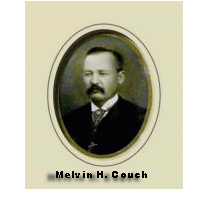
by Adelbert M. Scriber, Editor of The Republican Watchman, 1935.
Unpublished manuscript transcribed by his granddaughter, Susan Benton Schock, 2007.
The Melvin H. Couch Scandal
December 1913
The Masonic building has a story that is unique in the history of scandal. On the second floor of the Temple were offices and flats. Judge Smith had his office there; District Attorney Jacob M. Maybee had a flat there; John H. Smith, former pressman of the Bible House of New York City, had a room there. My newspaper office, The Republican Watchman, was also located there during this time.
To John Smith was given the unusual discovery of dry printing. Prior to that discovery, all book paper and newspapers were dampened before printing. Mr. Smith ran off several sheets while making ready, and they were so bright and shiny that he ran off an entire edition of the Bible on dry paper, and the books were the envy of every printing concern in the city. It was the forerunner of the beautiful printing we have today.
A writer of short stories occupied one room on the second floor of the building, and we printed his stories for him. They were just a column in length, and we pulled thirty or thirty-five proofs. These proofs were sold to newspapers all over the country for a dollar each. On this same floor, Melvin H. Couch had two law offices. So the Masonic building had an interesting colony.
My brother, Bert, and I had previously boarded with Mrs. Charles Ennis, who occupied the house at the top of the old village hill in Monticello, known as the Menzies House, but at the time of this story, we were living on West Broadway, although we still visited the Ennises frequently.
Four doors below the Ennis house lived Melvin H. Couch, former District Attorney, at the time that the Masonic Temple story surged. (Mr. Couch had been beaten by George H. Smith, the “boy lawyer” from Woobourne, who won with the help of many Republican leaders who would rather take a chance with him than with the ex-District Attorney).
One Sunday afternoon, we went to see the Ennis family. One of their new boarders had just come to town the day before. She was an amiable young lady who was peddling the book of a well-known author. We visited with her, looked over her books, and I agreed to buy a book for the purpose of giving her the necessary encouragement. I gave her a list of names of folks who I thought might subscribe, and among the names was that of Melvin H. Couch. In humor, I explained to her that he was a lover of the fair sex and did not easily tire of their companionship. As we sat there talking, Mr. Couch was actually coming up the hill, and I said to the lady bookseller, “Here comes Mr. Couch! You can sell him a book, I’m sure.” He stopped and tipped his hat to the folks sitting on the stoop and then stopped to talk to Mr. Ennis, who was an invalid and was sitting in a wheelchair. Mr. Ennis introduced the smiling book agent to him. The next day, she called at his office and sold him a book. In two weeks, she had completed her canvas of the town and had sent in her orders to the publishing house, and had presumably gone home.
One day, when Mr. Couch and I were talking in front of the Masonic building, he said that he had a very suspicious wife. “She gave me hell this morning on the assumption that I had a woman in the house while she was away on a three-week vacation. She found two red threads in the bed and claimed that she had traced them to some woman. The truth of the matter is,” said the counselor, “Neal Benson of Neversink, who is one of my political lieutenants, was in town and slept in the bed. He always wears red flannel shirts in the fall and winter and sleeps in his shirt.”
Mr. Couch had developed foot trouble, which necessitated that the top portion of one of the toes of his shoe be cut open. He concluded that he would need to have a bed put up in his inner office and would sleep there nights instead of walking home, which seemed satisfactory to Mrs. Couch, who continued to launder his sheets and shirts. He usually went home on Sunday to have a nice dinner, read the newspapers, and talk to his wife. For two years, things went along that way without a hitch.
When Mr. Couch was District Attorney, he occasionally went out of town on business. Sometimes it was as a lawyer in a case of law, and at other times it was on matters of a personal nature. On one occasion, he was waiting for the Rockwell House bus to take him to the railroad station. With his little grip in hand, he was walking anxiously back and forth on the sidewalk in front of the hotel. Sitting on the stoop were Harrison Beecher, Dave Avery, Judge Smith, and Charles Barnum, and two or three other men of note.
Mr. Beecher started the inquiry, “Hey, Mel! Are you going away?”
Then Thornton A. Niven followed with, “ Are you going to the city, Mel?”
“Are you going to be gone long?” inquired Judge Smith. And thus the gibe went on.
Mel cocked his hat to one side and replied, “ Whither I goeth and whence I cometh is not for you son-of-bitches to knoweth!”
Then, in schoolboy fashion, they razzed him. “Whoo….. whoo! Mel.”
One evening when the lights were out on the lower floor of the Masonic building, I stood in the shadow of the doorway leading into the Republican Watchman office, waiting for Judge Smith. I heard the main door of the front entrance to the stairs open, and out stepped a woman wrapped in a coat with the collar turned up around her ears. It was only a fleeting inspection, for she turned quickly and hurried up the street to the Frank Leslie Hotel, later called the Feiner property (recently bought by the county for parking purposes and offices). “Wow!” I thought, “That is the little book agent or I am a sinner of a guesser!” The next morning, I told my brother Bert what I had seen and of my surmises, and I suggested that he become a waiting detective. A few evenings later, he told me that I was right! Still later, I saw the lady again. It was always about the same hour, and her walks were always in the same direction. It was probably about a month after I saw her that the scandal broke. Monticello and the county went into a prodigious session of gossip.
At twelve o’clock one night, when the town was deep in its slumbers and the lights were out, a woman rushed down the Masonic building stairs and ran across the street to the home of Dr. John F. Curlette. She rang the doorbell frantically and continued to ring until the Doctor opened the door.
“Come to the Masonic Temple, quick!” she said. “Your brother-in-law, Mr. Couch, is dying!”
“Who are you?” inquired the Doctor.
“I am his friend,” was the reply.
The Doctor grabbed his medicine kit and rushed across the street, taking the stairs two at a time, but found brother-in-law Couch dead. He was robed for the night.
The young lady confessed to the Doctor that she had been living with him.
“How long?” the Doctor inquired.
“Oh, for some time. Possibly a couple of years.”
“Well, I’ll be damned!” said the Doctor, who never swore. “Now, see here, I have to get you to hide away. The undertaker will be here in a few minutes, and Mrs. Couch will be notified, and should she find you here, she would raise a storm that would be unhealthy for you as well as the rest of us.”
So he hid her in the back end of a deep closet behind the hanging coats, among which was one that belonged to her. There she was perfectly safe until Mrs. Couch, looking in the closet for a suit of her husband’s, discovered the feet and legs of a woman. She yanked the girl out of there in a hurry, and in the light of the room, she looked into her face and asked the question in no uncertain tones.
“Who are you!......and what are you doing in that closet!”
“I am Mr. Couch’s housekeeper, and I hid in there away from you and the others who might visit this room tonight.”
“Mr. Couch’s housekeeper! A maid of honor, I suppose! You get into that coat of yours and get down those stairs just as fast as those nasty legs will carry you and do it quick!”
Someone followed her downstairs and told her the best place to get a night’s lodging would be at the County farm, and the way to the farm was pointed out to her, but she missed the way, and the break of morning found her wandering in the neighborhood of Glen Wild, cold, wet, and exhausted. In fact, without knowing it, she had been in the vicinity of Couch’s old home.
The Associated Press representative in Monticello telegraphed a story to New York City, and by noon the following day, the train from New York was loaded with reporters. The New York World (daily and evening) sent three reporters, one of whom was the celebrated Nellie Bly. Column after column appeared on the Couch story, and it developed into the sensation of journalism. My brother, Bert Scriber, covered the story for The New York Times and Associated Press and kept the wires hot. The papers ate it up like a chicken eats feed.
Cite this: Scriber, Adelbert M. Sullivan County Profiles. 1935. Unpublished manuscript. Transcribed by his granddaughter, Susan Benton Schock, 2007. Section: "The Melvin H. Couch Scandal" (December 1913). Transcriber's note: "I am finally getting around to sending you the story my grandfather wrote about the Melvin Couch scandal. I have this in a collection I call Sullivan County Profiles (little stories about local people written by my grandfather...never published.... but I think written for his own amusement, perhaps....and maybe also knowing that decades later they might have historical significance). This story will add a few more little details to the account. (I do suspect that my grandfather may have taken a bit of creative license with this, though!)." [emphasis added].
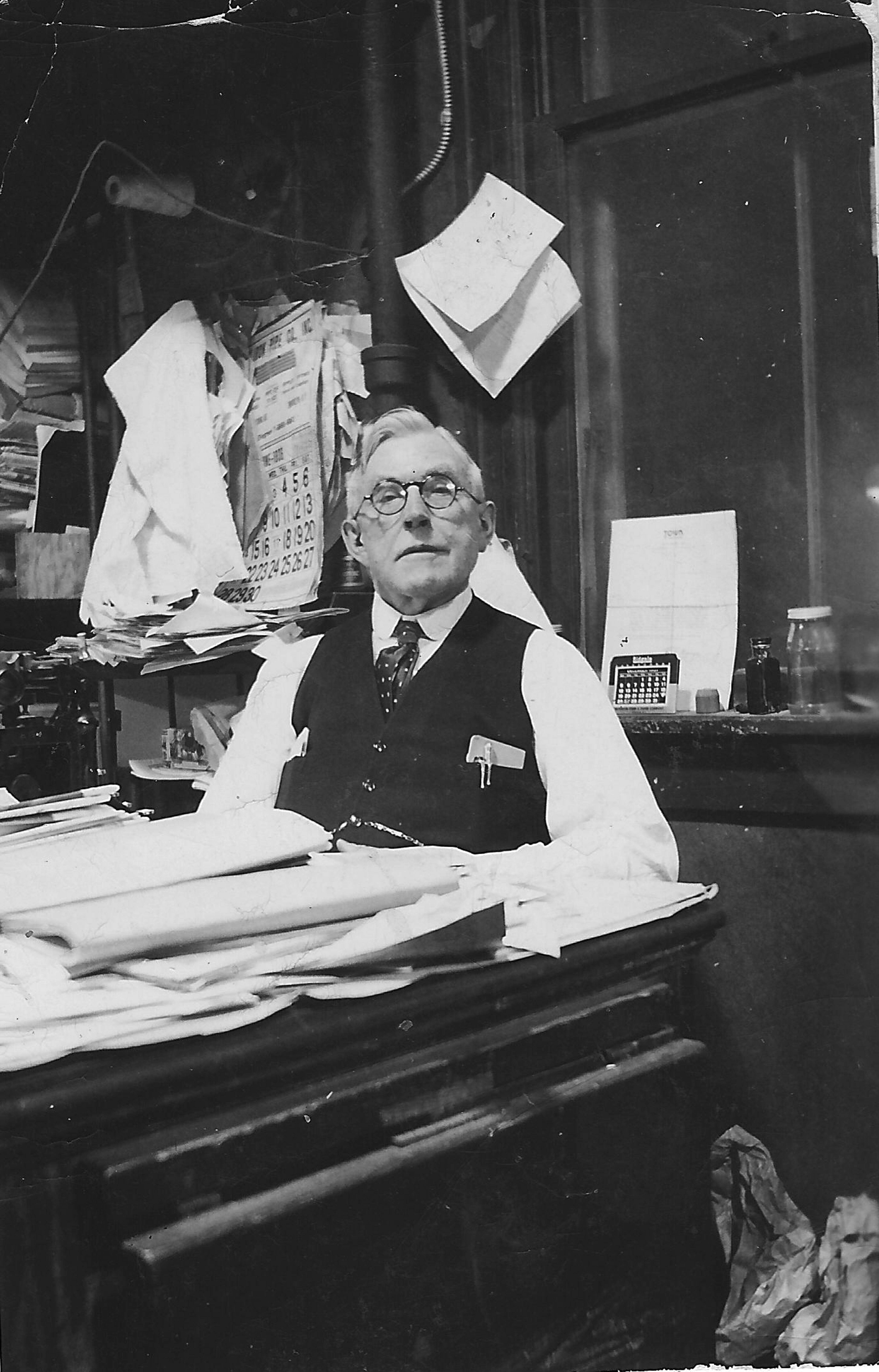
Adelbert M. Scriber - (1865-1948) Began career in his teens with Livingston Manor Times as the youngest publisher in NY State. Became co-owner of Republican Watchman with Charles Barnum in 1895 and sole owner, editor, and publisher in 1909, continuing until his death in 1948. As an inveterate writer created many stories and sketches of Sullivan County and published in 1927 an historical novel (Old Jed) a saga of local settlers and Native Americans. Director of the Sullivan County Trust Co., President of the Sullivan Co. Savings and Loan, Sullivan Co. Historical Society, Director of the Telephone Co., Charter Member and President of Rotary Club, President of Board of Education, Board Member of Methodist Church, Member of Washington Memorial Committee, Presidential Elector for NY (1936), and Delegate to Democratic National. Convention (1944) during FDR’s campaign. (Courtesy of Susan Benton Schock)
Tags
- Log in to post comments