
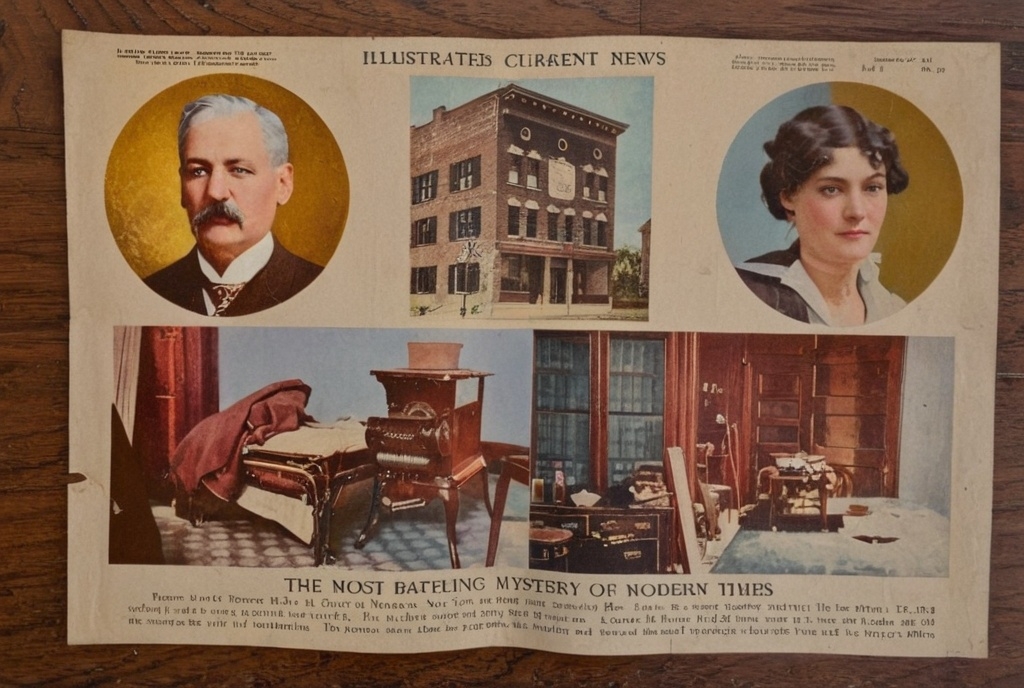
On December 23, 1913, shortly after her lover's death, Adelaide Branch stood in the Sullivan County Jail and told a crowd of reporters her own story. What follows is transcribed from the Atlanta Georgian. Segments were quoted in newspapers around the country. This one appears to be a relatively complete transcript (though it ends abruptly, cut short in editing). This is Adelaide's own story that she told to the crowd of reporters who were camped outside the jail, speaking in her own voice regarding the choices she made during her years in Monticello to be with a man that she loved. Her choice to live at close quarters with him, sleeping in his office closet for three years was out of an immediate and mutual affinity they each felt from the moment they met.
Citation: “‘Woman, ‘Love Prisoner’ In Lawyer's Office For Years, Tells Her Story.’” Atlanta Georgian (Atlanta, GA), December 23, 1913, 2.
Woman, 'Love Prisoner' In Lawyer's Office For Years, Tells Her Story
MONTICELLO, N. Y., Dec. 23, 1913 – Barred from the funeral of Melvin H. Couch, former District Attorney of Sullivan County, Adelaide Branch, the “wife of his heart,” told to‑day how she was kept in Couch’s office, a willing prisoner, for years. She begged piteously to be allowed to follow the body of Couch, the taciturn and brilliant lawyer, whose personality had held her as a love slave. Mrs. Couch objected to Miss Branch’s presence at the funeral.
“Why are they so cruel?” cried Miss Branch. “Don’t you know this man is part of me. I loved him; he was my life, my everything. Do you think a woman would be a recluse for years, a hermit, bitterly alone at times for a man unless she loved him with all the strength of her soul?
“They tell me his wife loved him. She may have been his wife by the law, but I was the wife of his heart. I stayed for him. I lost all my friends for him. Gave up the world for him. And yet I am to be denied the poor consolation of seeing the sod thrown on his grave.”
She told to‑day for the first time the full details of her strange romance, so strange as to be without a parallel even in the most imaginative of fiction.
She told this story dry‑eyed and composed. A woman of sufficient intellectuality to translate the works of French authors, skilled in the making of delicate and intricate embroidery, a competent stenographer, and yet not scorning to bake, scrub and cook for her “heart husband,” she is a striking personality. One forgets the old‑fashioned, haphazard garments she wears. Her heart slavery was too abject even for clothes; she did not dare venture out of Couch’s office to shop but once. She feared the prying eyes of Monticello.
“I know that my story may seem strange to you,” she said, “but it never seemed strange to me. Women meet men every day for whom they give up everything. Women always give up things. I am a woman.
“I loved Mr. Couch for fifteen years. When I first met him I was selling a life of Admiral Dewey by Murat Halsted. I went from office to office in Monticello, and at last, I never will forget the day I entered the office of Couch.
“He looked at me and in that look my heart was gone. It is a strange thing how, when one is proof against love, or thinks she is proof against love, as I thought I was, it is strange how the world changes with a look.
“We kept our love a secret for years. I came to see him at times, but I was cautious. Mr. Couch had a brilliant future and I used every caution, lest I would cast the slightest blemish on his name. There are 2,000 women in Monticello with 2,000 tongues and 4,000 ears. I was careful.
“About three years ago we talked things over. I wanted to be near him. Was I jealous of his wife and his daughter? Yes, I was. What woman wouldn’t be? I wanted him for myself. And I got him. I got him by giving up what many women hold dear, but I got him.
“We fixed up a little room in the rear of his offices. The wooden partition which separated this room from the offices did not reach the ceiling by two feet. I could hear what was going on, but could not see. I often heard Mrs. Couch talking. Little did she know who was on the other side of the partition.
“Yes, I lived in a cell, you might say, but it was a cell of my own making. It was not a pretty home, but I was happy.
“Mr. Couch had injured his ankle at an amateur race years ago. That was one of the reasons why I went to live in his office. He needed care. Mr. Couch told his wife that the long hill leading up to his home was too steep for him and he would thereafter eat at the office and sleep at the office most of the time.
“Sometimes he went home, of course. How I begrudged the time he was with the woman whom the law calls his wife!
“In the village they used to say that old Couch was getting crabbed and peculiar because he would stump off to the grocery every day to get provisions and come back with them tucked under his arm. They wondered why he didn’t go to his well-kept home. The grocery man didn’t know I was sharing those provisions. Nobody did.
“Every Sunday Mr. Couch went to his wife. There he dined in state. But things I cooked tasted better. He told me so.
“One time the wife of an attorney saw me lying half dressed on the bed in my little room. She had come in to look at some furniture and my door had been left unlocked through some accident. When she saw me this woman gave a little scream and retreated. She never told, and this story I am telling may be no news to her. I can remember how furious Mr. Couch was at that. He was so angry he seemed out of his head.
“I was made Couch’s cook, his stenographer, his scrub woman and, yes, his wife. I spent my days and nights a prisoner. Sometimes I ran out when it was dark, but not often. It was too risky.”
Tags
- Log in to post comments