
Social Context
Gilded Age to Progressive Era
Adelaide M. Branch -- known at times during her life as Mary Douglas -- was born in 1873 in Hartwick, New York, a small village in the Catskills where the rhythms of rural life masked the seismic shifts reshaping America. By the time she reached adulthood, the Gilded Age’s glittering excesses had given way to the Progressive Era’s restless calls for reform. The nation was a paradox: a land of industrial titans and tenement slums, of suffragists marching for the vote while Black Americans were disenfranchised by law and lynched by mobs, of robber barons and radical labor organizers who dared to demand a fairer world. The Panic of 1893 had left scars, and the 1907 financial crisis had proven that capitalism’s booms and busts were no accident but a feature of the system. Into this fraught landscape stepped writers, activists, and agitators—people like Upton Sinclair, whose The Jungle (1906) exposed the horrors of the meatpacking industry, and his wife, Mary Craig Sinclair, a feminist and socialist in her own right.
Adelaide Branch’s life would intersect with theirs at a moment of personal and political rupture. In late December 1913, she found herself detained in the Sullivan County Jail in Monticello, New York, her name splashed across newspapers in connection with the death of her lover, Melvin Couch. The details of the case -- whether tragedy, self-defense, or something more complicated -- would be picked over by the press and the public. But what happened next was extraordinary. From hundreds of offers of aid, Branch chose the Sinclairs. Why them? Perhaps she recognized kindred spirits in their defiance of convention. Or perhaps she understood, instinctively, that in a world quick to judge a woman in her position, she needed allies who saw the system, not the individual, as the criminal.
The Sinclairs did not disappoint. They connected her with Dr. James P. Warbasse, a physician and self-described radical socialist in New York City, and his wife, Agnes, all fellow travelers in the city’s radical circles. The Warbasses were part of a nationwide network of progressives -- anarchists, suffragists, labor organizers—who believed in a society remade from the ground up. They helped Branch resettle in New York, where she would live out her days until she died in 1948, the same year the world was still reeling from war, and the Cold War’s chill was setting in.
Her story is a sliver of a larger moment: the early 20th century, when the old order was under siege and the new one not yet born. The Progressives had won some battles—child labor laws, the income tax, women’s suffrage (though not for all women) -- but the forces of reaction were already regrouping. The Red Scare of 1919–1920 would soon criminalize the very ideals that people like the Sinclairs and the Warbasses championed. And yet, in the cracks of that turbulent era, there were acts of solidarity, defiance, and reinvention. Adelaide Branch’s choice to turn to the Sinclairs was one of them. It was not just a lifeline; it was a statement. In a society that policed women’s bodies, their desires, and their very right to exist outside prescribed roles, she reached for the hands of those who believed another world was possible.
What follows is the story of a woman who refused to be defined by scandal or sorrow, who navigated a landscape of constraint and possibility, and who, in her quiet way, became part of the hidden currents of resistance that have always run beneath the surface of American life.
Media Ethics
How Sensationalized News Coverage Shaped -- and Distorted -- Adelaide’s Legacy
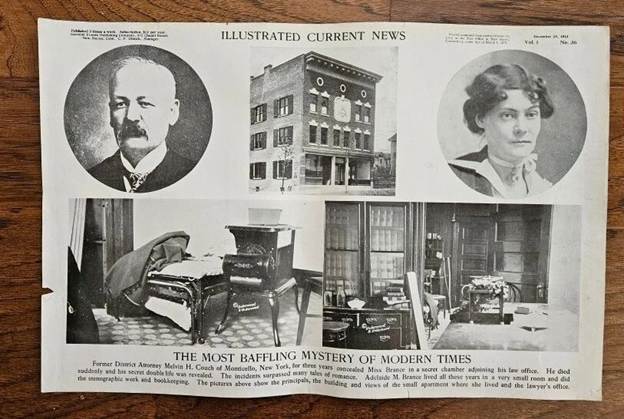
On December 23, 1913, the Illustrated Current News supplement (pictured above) didn’t just report the scandal of Melvin Couch and Adelaide Branch -- it rewrote her life as myth. In an age before journalistic ethics, where newspapers thrived on scandal and spectacle, Adelaide wasn’t a woman with agency, ambitions, or constraints -- she was a mystery to be solved, a curiosity to be gawked at, and a cautionary tale to be whispered about. The media’s framing didn’t just shape how the public saw her in 1913; it cemented a legacy of distortion that would follow her for over a century.
The headlines said it all: “The Most Baffling Mystery of Modern Times.” From the outset, Adelaide was cast as an enigma, not a person. The supplement’s language -- “concealed many valuable secrets”, “the woman in the closet”, “a willing prisoner” -- painted her as either a schemer or a victim of her own strange whims, never as a woman navigating survival in a world that offered her few options. The photos of the “secret chamber” were staged to look like a dungeon of intrigue, complete with rumpled bedding and an ominously open safe, though contemporaries described it as little more than a utilitarian closet where Adelaide worked as Couch’s stenographer. The power imbalance between them -- a wealthy, connected District Attorney and a working-class woman with no family to turn to -- was erased entirely. Instead, the media spun a tale of voluntary seclusion, as if Adelaide had chosen this life out of whimsy rather than necessity.
What the papers didn’t mention was the economic coercion that likely kept her there. Adelaide had no independent income, few references, and -- after years in Couch’s employ -- no easy way to leave without risking destitution or worse. Yet the Illustrated Current News and its ilk framed her as a puzzling figure, a woman who had somehow tricked herself into captivity. This narrative stuck. Later historians, true-crime writers, and even local lore repeated the same tropes, assuming Adelaide must have been complicit in her own erasure. Her skills -- her training as a stenographer, her work as a bookkeeper -- were overlooked in favor of the titillating image of a woman hidden away, as if she were a character in a Gothic novel rather than a real person navigating a world that had already failed her.
The staging of “evidence” only deepened the distortion. The photos published in the supplement were carefully composed to mislead. The “law office” shot included a dramatically open safe, implying theft or secrets, though no records suggest Adelaide ever stole from Couch. The “secret chamber” was lit to appear dark and claustrophobic, though accounts from the time describe it as a small but functional space where Adelaide both worked and lived. These images weren’t just illustrative -- they were propaganda, designed to sell papers by playing into the public’s morbid curiosity, and to uphold civic order by making an example of those who transgressed its boundaries.
And they worked. For decades, these staged photos were treated as fact, reused in pulp magazines, true-crime books, and even modern retellings, ensuring that Adelaide’s story would forever be seen through a lens of sensationalism rather than reality.
Most damning of all was the absence of Adelaide’s voice. The supplement quoted no one directly -- not Adelaide, not her family, not even Couch’s colleagues. Instead, it relied on anonymous speculation: “It is believed…”, “Sources suggest…”, “One can only imagine…”. Adelaide was never given the chance to tell her own story, and the media’s relentless focus on the salacious details drowned out any possibility of nuance. As a result, she became a blank slate, a figure onto which readers could project their own biases. Was she a victim or a vixen? A gold digger? A madwoman? A criminal mastermind?
The papers offered no answers, only sensationalized questions, and the public was left to fill in the gaps with their own prejudices.
The long-term ripple effects of this coverage were devastating. In historical records, Adelaide was reduced to a footnote -- “the woman in the closet”, a curiosity rather than a person. Genealogical records omitted her entirely; she appeared in no census after 1910, likely due to the stigma that followed her. In popular culture, her story was rehashed and embellished, turning into a pulp-fiction trope by the 1930s and ’40s. Some accounts claimed she was a spy; others, a blackmailer. The truth -- that she was a woman who felt out of options in a world that offered her none -- was lost beneath layers of media-invented myth.
But the distortion didn’t end with the newspapers. It seeped into history itself. Later retellings, even those claiming to be authoritative, often parroted the 1913 media’s language, describing Adelaide as a “woman of mystery” without questioning the structural inequalities that shaped her life. Meanwhile, Melvin Couch -- despite his role in the scandal -- was portrayed as a tragic figure, a once-respected man brought low by circumstance. Adelaide, by contrast, was remembered as the scandal itself, her humanity erased in favor of a sensationalized caricature.
Reclaiming Adelaide’s story means dismantling the myths the media built around her. It means centering her labor -- her skills as a stenographer, her intelligence, her resilience -- instead of reducing her to a passive figure in someone else’s drama. It means analyzing the media’s role in shaping her legacy, exposing the class and gender biases that allowed a powerful man’s actions to be excused while a woman’s were scrutinized. And it means filling the silences left by biased reporting, whether through speculative reconstruction (like fictionalized journal entries) or by placing Adelaide’s story alongside those of other women -- like Eva Coo or Stanford White’s victims -- who were similarly sensationalized and misrepresented by the press.
The 1913 media didn’t just report on Adelaide M. Branch. It invented her. But the invention doesn’t have to be the final word. By peeling back the layers of distortion, we can begin to see the woman beneath the myth: not a mystery, not a curiosity, but a person who lived, worked, and fought for survival in a world that was determined to erase her.