WHAT THE WORLD OWES TO SPINSTERS
MARY A. DOUGLAS
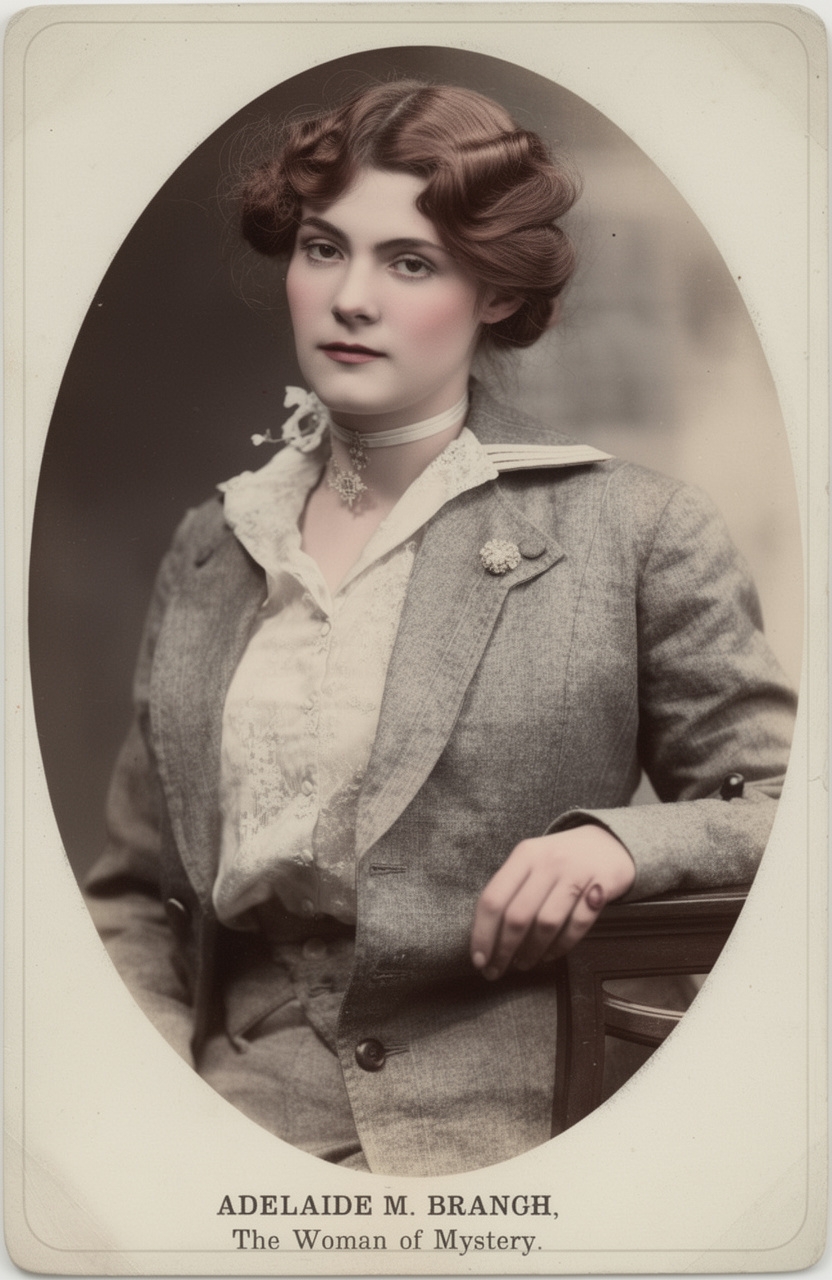
[also known as Adelaide M. Branch]
Published in The Forum, July 1917, pp. 99-113
To the average woman, the intensive industry of matrimony, under its present charter laws, leaves small room for the consideration of mere humanity. The business of looking after a man and his progeny is a solemn one, requiring time, energy, and a fair degree of tact. The business of being looked after by a man is even more serious, calling for all the talents of a highly specialized type of woman.
Roughly classified, there are three varieties of married women. There is the woman centered in husband and children, revolving in an orderly orbit around the pivot of her home. The beginning of her life vocation was the bringing of these children into the world -- in itself no light undertaking. Then in bewildering succession comes all the unholy catalogue of children's diseases and accidents, and liabilities. So the active years go on, through the successive stages of childhood and into the peculiar unfledged state of adolescence, and still there is no surcease. There never will be. They are her children.
The daily routine of caring for a home and family, like the time-honored brook, goes on forever. The rivaling of her neighbor who has, the putting of envy into the heart of her neighbor who has not, the stretching of a $1200 income over $2000 worth of desires; these are problems in higher mathematics. And hand in hand with home-making and child-rearing goes the training of a husband in the way he should go, which is a mighty serious, nay, arduous undertaking. With the most humane intentions, results are not always satisfactory.
And then some day comes that final, rather awesome business of lying down with folded hands—a little weary, a little wrinkled and shop-worn, but at last the hands are folded. What place has there been for humanity? This is the particular vocation in which women has specialized since those historical days when Eve tasted of the apple and tempted that good man Adam.
There is the second class in the married sisterhood: those whose business it is to be looked after by man. Beauty specialists, modistes, bridge, teas, dinners, receptions, limousines, yachts, theatres, operas, travel, fashionable lectures, popular philanthropy --all the varied activities of the center of the universe. Oh, it's a hard job, this being looked after by a man! But why dwell upon these finished products of a fine-spun fabric of civilization? They and humanity have yet to meet.
In the third class are those with a fair income, a widening horizon, a reasonable number of children, whose brains are nourished with blood from the heart. They give of themselves not only in the home but without. Their hands are ever ready to reach out in the clasp of sympathy and practical assistance. For such, let humanity give thanks.
Which brings us to the spinster. Unhampered by the responsibility of a husband, giving to the world no hostage of children -- what has she contributed to the human quota? As she has lost in intensiveness, what has she gained in extensiveness? And what has humanity gained?
As those within the guild of marriage differ, so in the unmarried sisterhood there are spinsters—and yet spinsters. There is the ingrown species, feeding upon herself and growing meager in soul and mind and body upon so sparse a diet. It is not of her that we speak.
There is another type, indigenous perhaps to the soil wherein flourished our grandmothers and great aunts, but by no means so nearly extinct as naturalists would lead us to believe. In stray nooks and corners she can still be found. This is the gentle, unassuming, useful spinster; the woman of soft shy words and many deeds. Disrespectfully called by her sister who bears the name of a more or less questionable male specimen, "That old maid," she is dependable in stress and strain. Taking into her pale life no reflected brilliancy, she passes; and the faint ripple of her tranquil existence is lost to sight. But who knows? This that we name Life is but the one side of a very intricate tapestry woven of many threads by many hands.
In this type are all the latent possibilities of the spinster who plays so important a part in modern life; of the spinster who has made and still is making history. It is of her we speak.
In the long-distant past there lived one of this number, beautiful, intelligent and liberal. She taught not only mathematics and science, but was the apostle of liberality, the incarnation of the spirit of freedom. This was Hypatia, of Alexandria. It was the age-old war between religion and science; the battle of enlightment against ignorance -- and
ignorance won a sanguine victory. Too proud to turn from an infuriated mob of priests and their followers, Hypatia's beautiful body was hacked and hewed and torn and then burned—in the name of religion. Later her works in Alexandria were destroyed by another frenzied rabble, so that to-day the exact nature of her teachings is not known. But, immortalized by Charles Kingsley, her undaunted spirit lives -- and in this idealized form who can tell what it has accomplished ? What seeds, you ask, have been sown in virgin soil?
There was Elizabeth of England -- Elizabeth of the ready tongue and forceful language. With "The Virgin Queen" man was a side issue, a plaything or a victim of the block, as whim dictated. Unhampered by a legal mate, she ruled long and, according to the times and the idiosyncrasies of royalty -- gloriously. Perhaps had Elizabeth possessed a lawful husband or two or eight, she would have followed the example of her well-known progenitor and disposed of them in as finished a manner as did Bluff King Hal of Anne Boleyn of the slender neck—and still have ruled gloriously. That we may not know. But this we do know: By refusing to marry Philip of Spain, she brought religious harmony into mutilated and bleeding England. At heart non-partisan, while espousing the cause of Protestantism, she cleared away the smoke of the holy fires kindled by Bloody Queen Mary.
Good advisers, the swinging of the pendulum, fatality, if you choose, may all have played their part in that epoch. Yet Elizabeth's personality stands by itself. And the era in English history, which for brilliant achievements in every field stands by itself, is forever irrevocably linked with the name of Elizabeth.
"I had three paths among which to choose," wrote Florence Nightingale in her diary for 1850. "I might have been a married woman, a literary woman, or a Hospital Sister." And the world knows which path she followed. The records of her work in the reeking cesspool of Crimea read like a tale of unreality. To the stricken and dying soldiers, she was Longfellow's " Lady with the Lamp," tender, compassionate. Countless souls in that inferno of mutilation and pestilence passed out into the night, lighted by the gentle radiance of Florence Nightingale.
All this she was and more, much more—else she had not been Florence Nightingale. For she was that rare species -- a balanced human being; in her intellect, will, and emotion were coordinated. As an organizer, a genius in planning and executing, she stands in the front ranks. From a chaos of filth, she evolved order, system, comparative comfort, and cleanliness. Food, laundry, medicine, clothing, surgery, government correspondence—no detail was too minute for the personal attention of Florence Nightingale; no undertaking too stupendous. "It's the Bird's duty," observed the gallant gentlemen around the hospitals, who had made such a mess of things. And the duties which the "Bird" did not shirk have made pages in English history.
But invaluable as were Florence Nightingale's services 10 contemporary England, it was the fruit borne from the seed sown upon an aftermath of carnage which makes the world a heavy debtor to the Spinster of the Crimea. It was Florence Nightingale, well-born, of social standing, a popular heroine, who made nursing fashionable in England. It was the organizer and systematizer of the Crimean hospitals who with the fifty thousand pounds sterling presented to her as a testimonial, endowed the first hospital in England wherein women could receive professional training in nursing. It was she who devoted the remaining years of her long life to the reformation of hospital conditions in general; who conceived and carried into execution the plan of sending efficient nurses into private families. And again it was Florence Nightingale, the nurse of rare experience, who wrote "Notes on Nursing," a work valuable to-day; invaluable when written.
The waves that she set into motion on that side of the Atlantic have washed against our own shores; they lap on foreign strands—and yet they widen.
And what of that other debt the women of the world owe to Florence Nightingale? The daughter of a refined family, with all the narrowness of refinement, she struggled in a stifling atmosphere for freedom, individuality, the right to live her own life -- she struggled -- and won. Is there anything which women owe to Florence Nightingale -- a voluntary spinster?
In the century that has passed, many have toiled with painful steps along the rugged trail blazed by Florence Nightingale—women married and women unmarried. To America belongs Clara Barton, whose name and that of the Red Cross, with all its network of ramifications, are synonymous. As a child she was unassertive, acutely, torturingly shy -- for herself; fearless, capable, aggressive, for others— those weaker others. And in the embryo woman is found the keynote of her life work; of her contribution to the cause of humanity.
Clara Barton, aroused to action, by conditions in the Patent Office at Washington, where clerks stole and sold the ideas of inventors seeking government protection, asked for and obtained the position of head clerk. She was received with rudeness, insults, insubordination. But before she left, reform was instituted.
It was she who conceived and carried into execution the plan of the actual presence of the nurse upon the field of battle. Bound to no organization, acting solely upon her own initiative, throughout the crimson days of the Civil War, Clara Barton and her wagons and supplies followed in the wake of the Union Army. Capable, tireless, fearless, her practical assistance, her knowledge of. surgery, her skilled nursing, gave "first aid to the injured." It was also a part of her self-imposed service to keep records of the wounded, dead, and the places of burial. After the war, through these lists and her efforts, over thirty thousand men, living and dead, were accounted for. What did this alone mean? For some- where were mothers and fathers, wives and sweethearts, to whom these thirty thousand were not simply soldiers among the missing—they were human beings.
It was Clara Barton who after long and persistent effort induced the Government of the United States to join in treaties creating the International Red Cross Society. But an important obstacle stood in the way of the immediate activities of this organization. The United States was not engaged in war; there was no prospect of war. With this situation, the ever-active brain of Clara Barton grappled. The result was that in the absence of war, or its shadow, the Red Cross became a scarlet-winged messenger of peace. Where there was flood, famine, pestilence, earthquake, disaster, there the Red Cross worked. And its central station was Clara Barton.
And what of those other heroic pioneers -- Doctors Elizabeth and Emily Blackwell? And "heroic" is used advisedly.
Nursing might do for women -- it was fairly feminine and genteel and men didn't care much for the job anyway. But medicine -- that honorable and hoary and barnacle-encrusted prerogative of MAN. It was to laugh! In addition, the presence of young women in the classes and clinics with young men was -- not nice. The suggestion outraged all the delicate masculine sensibilities and traditions; it brought the blush of scarlet hue to the coy masculine cheek.
So Elizabeth Blackwell battered with poor success at
the doors of various medical colleges, won a reluctant admission to Hobart College at Geneva, New York, and left it Elizabeth Blackwell, M.D. And her sister Emily was a close second.
To do these things in those good old conservative days required fine, rare courage -- the courage of a woman and a spinster.
Those barred doors that Elizabeth Blackwell, with frail hands, forced open will never close again. Through them have passed and yet pass and still shall pass women -- the women of America. This is their heritage, earned for them by the power of brain and will and heart that was Elizabeth Blackwell, physician.
In the days of venerable Rome, there lived a matron -- by name Calphurnia, by profession an advocate, an eloquent pleader before the tribunals of justice. But Calphurnia's gift of volubility found not favor with man. For it is recorded that because of "her excess of boldness and by reason of making the tribunal resound with bowlings not common in the forum," she became unpopular. And so naughty Calphurnia's plaything was taken from her -- she was disbarred, and like her erring sister in the beautiful garden, the curse fell not only upon her but upon all her descendants -- in the female line. Roman law decreed that because of Calphurnia's indiscretion, thereafter no woman might practice law. And as Roman law is a close second in authority to the precepts of the Bible, the silver eloquence of woman's tongue was heard no more in courts of justice for long and silent centuries.
Then the inevitable happened. In 1638 there came to the colonies from England one Margaret Brent, "spinster and gentlewoman," kinswoman of Leonard Calvert, first Governor of Maryland. In 1647 Leonard Calvert, brother to and attorney for Cecilius Calvert, second Lord Baltimore, died, leaving Margaret Brent his sole executrix. On the strength of her appointment as executrix, Mistress Brent also claimed the right to act as attorney for Cecilius Calvert. Both claims were denied. But Margaret Brent, spinster and gentlewoman, fought her claims to a finish -- and won both. For it is recorded that the Provincial Court decreed that she "should be received as his Lps [sic] attorney." And it is further recorded that she not only frequently appeared in court as his Lps [sic] attorney, but also as prosecuting and defending lawyer for her brother, and no objection was raised.
But this is an isolated instance; a pebble that sank with scarce a ripple. Two hundred and a few more years rolled onward and still the curse of Calphurnia of the over-active tongue rested on woman. Then in America, in the middle of the Nineteenth Century, the battle was on.
In 1875, Miss R. Lavinia Goodell, already admitted to the bar of the circuit court, made motion to be admitted to practice law in the Supreme Court of Wisconsin. Motion denied. To quote from the finished language of Mr. Chief Justice Ryan, who delivered the opinion of the honorable court:
"The peculiar qualities of womanhood, its gentle grace, its quick sensibility, its tender susceptibility, its purity, its delicacy, its emotional raptures," were not considered fitting qualification for the Supreme Court of Wisconsin.
But to the contrary, notwithstanding, R. Lavinia Goodell, unmarried, won. A law was enacted, enabling
women to practice law in the courts of the State of Wisconsin. Another wedge was entered.
It is difficult to make out a good case for women in the Christian ministry. For in I Corinthians, xv, 34, Paul the Apostle says with authority, "Let your women keep silence in the churches."
And as Paul was not only a man but a saint this nearly settled the whole matter. But not quite. For to-day there are women, regularly ordained, holding pastorates, and preaching the Gospel. Not many, it is true; but those women among the laity who no longer "keep silence" restore the balance. And there had to be a beginning.
The first woman in America to be ordained as a minister of the gospel was Antionette Brown in 1853. Three years before, she had completed the theological course at Oberlin, Ohio, but had been refused a license to preach. Through the intervening years, she preached upon her own account, but in 1853 sh^ was regularly ordained by a circuit of Congregational ministers in Wayne County.
Antionette Brown later became Antionette Brown Blackwell; but in those days of early marriages a woman born in 1825 and wedded in 1856 can safely be classed in the ranks of spinster. And besides as an argument for the affirmative she is alluring.
This is the third side of the preempted masculine triangle; but the activities of women who have not been invested with the sacred masculine title of the Ancient and Honorable Order of Matrimony have by no means been limited to the pursuit of law, medicine and the pulpit.
Who conceived the plan of a seminary for girls, endowed by free gifts, according to the tradition-hallowed custom for young men? Who, equipped with the clear-cut mentality of a leader and organizer, made this creation of the brain an embodied actuality? Who, with tireless energy, scurried hither and thither throughout conservative New England, begging contributions, accepting any sum from one hundred dollars to six cents, for a thankless and apparently a hopeless cause?
Mary Lyon has long been dead, but Mt. Holyoke, and all that this creation of her soul and mind stands for, lives.
From the brain of a little farm girl, paying for her first tuition in a coverlid, spun, woven and dyed by her own hands, seeing as she went on the necessity of vital education for middle-class girls, came the inception of the system of modern education for women.
"If you want to have a polished education, have a good foundation. You will find it hard to polish a piece of sponge; but not to polish steel," was one of Mary Lyon's precepts. And to the securing of good foundations she gave her life. Wedded to the institution which she founded; mother to every girl who came within its walls; akin to all the world of mind and soul-starved women -- this was Mary Lyon. She lived; she served; she died prematurely, exhausted by her service. Somewhere there is a debt.
We are familiar to-day with the organized and evolved system of State Hospitals for the Insane throughout the country. But what do we know of Dorothea Lynde Dix? Of the life blood that she gave in behalf of that great fraternity of the sick and wounded in mind and soul ? What actual information do we of this young and sufficient century possess regarding her tireless years of effort to ameliorate conditions for that other member of the soul-sick brotherhood -- those who drag out their years within prison walls?
Many years have passed since 1837; but the record of Dorothea Dix's years of devotion and struggle are as important a page as history has ever written. A page that should be reread. For to-day, with all our boasted progress, the entire network of our prisons, even our institutions for those whom society acknowledges to be of diseased mind, are a canker eating into the heart of the community. So long as they exist, civilization, in its actual sense, in what it shall yet come to mean, does not exist. So read the history of Dorothea Lynde Dix. For the doors of the institutions for the insane and the criminal are wide and hospitable.
"I know only woman, and her disfranchised," said another woman. When Susan B. Anthony began her long and unflinching championship of an ostracised cause, colleges and high schools were closed to women. Medicine, law, the pulpit, and a host of minor occupations were barred to them. They could neither hold, will, nor devise property and had
not even the right to their own earnings. To the righting of these wrongs she consecrated her life.
What Susan B. Anthony and the heroic little band of women who linked strong hands have accomplished is too
well-known to need feeble reiteration. Its record is written in the Cause of Woman as it stands to-day. The vivid personality of that gallant, fearless fighter who came in 1820 and passed in 1906, is still too vital and living to demand pale reproduction.
But perchance it may not be quite so well known that the agitator, the pleader, the organizer, who succeeded in arousing public sentiment, 400,000 strong, in a petition to Congress for the introduction of the thirteenth amendment, was also Susan B. Anthony.
In Frances Willard and Susan B. Anthony, there were these similarities: Each was first roused to action by the horrors brought to woman, home and communities through liquor. Each saw in woman enfranchised the solution. Each was self-reliant, fearless, a born agitator and organizer. But there was this divergence: With Frances Willard, wide as was the field she covered, valuable as was her contribution, her work was intensive rather than extensive. All other issues were but the means to an end -- abolition of the liquor traffic. An end as important as was that other traffic in human souls, so long abolished. She gave her life, her energy, her genius, to the cause and the organization with which her name is synonymous. Its history is her biography.
In astronomy, we find the names of Caroline Herschel in Germany and of Maria Mitchel in America.
Caroline Herschel worked in collaboration with her brother. Sir William Herschel of fame, receiving as a reward of merit the appointment of assistant astronomer -- a hitherto unheard of distinction for woman. But during her ninety-eight years of residence upon this planet, she found time to discover on her own account eight comets, any quantity of nebulae, and to present the Royal Society with a catalogue of five hundred and sixty stars. Quite a tidy record for a woman and a member of the untitled sisterhood.
In 1847, Maria Mitchel also discovered a neat little comet of her own. This brought to the young astronomer fame and practical recognition. In 1865, she was called to fill the chair of astronomy in new-born Vassar. Her years of service there are an open book that " He who runs may read."
When asked why she had never married, Rosa Bonheur, the only woman in France to wear the red ribbon of the Legion of Honor, made this characteristic reply: " Well, sir, it is not because I am an enemy of marriage; but I assure you I have never had the time to consider the subject."
Charlotte Cushman, the greatest tragedienne America has ever known, voiced similar sentiments in full-blown language. " Art," said she, "is an absolute mistress; she will not be coquetted with or slighted, she requires the most entire self-devotion, and she repays with grand triumph." And Charlotte Cushman should have known whereof she spoke, for to art—and art alone -- was she wedded.
In the field of literature the list of those who apparently" never had time to consider "the subject of matrimony is a notable one. England can claim Jane Austen, that painter of pen-portraits in miniature, creator of real life in a period of stilted artificiality.
To England also belongs the unique Bronte trio. It is true that Charlotte, at the age of thirty-nine, married, dying within the year. But her creative work remains that of the solitary woman.
Harriet Martineau's place in the Hall of Fame of the House of the Unwed rests not alone upon the popular romances she wove around the weird topic of political economy. She was the active partisan of three causes: freedom of trade; freedom of the slave; freedom of woman -- none of them subjects of popular enthusiasm during that epoch.
Then there was Hanah More, Frances Burney, Maria Edgeworth, Adelaide Proctor, Jean Ingelow -- all unmarried and all known to fame.
The name of Margaret Fuller is an early star in the firmament of young literary America. She lives to-day, not so much as the woman of letters and erudition who dabbled in written words -- many words -- but as Margaret Fuller, a bundle of eccentricities and genius -- cordially disliked by many, understood by none. Like Charlotte Bronte in England, when in the late thirties she married -- and died within a short time. But it is the work and personality of Margaret Fuller, free and unattached, that is vital.
No history of literature in America is complete without the name of Louisa M. Alcott. She stands in a class by herself. Her stories, fresh with a dew of youth and hope and cheer, refute imitations. The children she created, vital, wholesome, real, even as she was real, are the hostages she gave to humanity. What mother has given more?
Let the list be completed with the names of the Carey sisters -- Alice and Phoebe; with that of Elizabeth Stuart Phelps, whose finest creative work was done while unmarried; with Sarah Orne Jewett and her creations of reality. And then let us desist. For many names are wearisome to the flesh.
And these are the spinsters of the past; the women who have made history. What of the spinsters of the present, the women who are making history?
Statistics -- to pelt the unfortunate reader with these deadly missiles—tell us that among women of eminence 16.3 per cent have not been married; that 49.2 per cent of this number belong to the Nineteenth Century, and that this percentage is on the increase. This has a convincing and statistically sound, pleasing to the ear. But be this as it may, the spinster of deeds and actions is present with us.
There are the unmarried women of to-day whose names are of national and international importance. Jane Addams, Ellen Key, Anna Howard Shaw, Helen Keller, Ida Tarbell, Maude Adams, Anne Morgan, and Helen Gould -- late of the ranks; these women and their works are known. For the chapter which they are writing is still damp from the press; the ink upon its pages is yet undried.
But there are other women—those countless others in the ranks of the unwed. Their names are unknown to fame; their field of activity is narrower. But, nevertheless, they are achievers, history-makers, more or less—perhaps more. For with our' peculiar sense of values, with our fatal lack of perspective, our human inability to see in wholeness, we may not know. But this we do know: The unmarried woman of to-day, in every field, is a force with which to reckon.
This, however, is not a brief for spinsters. In the nature of things it cannot be, for the greatest maker of history on record was a married lady, in excellent standing, as a monogamist. When Eve, wife of Adam, in an incautious moment tested the apple and overpersuaded that excellent and well disposed man, she set up an endless chain of indebtedness for poor humanity. In the shadow of the huge rolling snowball of Eve's achievement, the minor activities of spinsters and non-spinsters are lost to sight.
In the painful interval that has elapsed since the epoch- making days of the wife of Adam there have been many other women, all married more or less, whose names flame from out the grey pages of history. To return to the iron-clad statistics already arrayed against the reader, 16.3 per cent of the women of eminence have not been married. This presents a neat problem in mathematics which, allowing for human error, leaves a balance of 83.6 per cent for the other side.
It is true that many of this number were those specialists in sex upon whose whim of the moment rested the life of human beings, the affairs of state, the wars of nations.
The list is a long one; a dazzling one on paper, when not linked with the physical actualities of those merry days of lust and filth and slaughter. It is not harmonious to associate these joyous and unfettered ladies with so uninspiring an institution as matrimony. Yet, by grace of statistics, a quite lawful husband is commonly discovered lurking in the background of time or eternity. However, accident or honorable motives of ambition, finance, or state reasons can ordinarily be offered in extenuation.
The debt the world owes to these women is a heavy one. Just how far their deadly sexual appeal to the figure heads of history has impeded humanity as human beings cannot be estimated. How many of the chapter titles of today's civilization, with its open pages of greed, luxury, poverty, sensuality, disease, artificiality and inhumanity have been written by these self-seeking adepts in sex will never be known. Dead, they have been immortalized by historians. Naughty, but from a masculine standpoint, exceedingly nice and desirable. Women invested with a mysterious charm; the favorites of rank and loyalty; the rulers of rulers; the radiant beings for whom the common people were privileged to supply jewels, money, servants, estates, and all the other necessities of royalty and its mistresses. Reprehensible, of course -- not the parasitic existence, the draining of the life blood of the people, but the little lapse from chastity, that premium jewel in every good woman's crown of virtues. Reprehensible, but charming and romantic -- in the reading.
Let us leave them. Their bodies have long since been purified by clean earth. To return to that wholesome standby of statistics -- the remainder of that 83.6 per cent so carefully computed.
There are the women who have lived and long since passed, and who, in living, found something more than vanity, intrigue, unholy luxury, and subjugation of man through sex. Their vision, even as is ours, was limited; their horizon dark with clouds. They were crude, even as we of today shall be crude to those of a finer and truer civilization. But afar, though dimly, they beheld a vision.
There are the women close to our own generation; those who have achieved in art, science, literature, who have struggled and won upon every battlefield of woman's endeavor. Who have given the blood that was themselves to a jeering world. These are the women who, with tireless hand,s have written, and still are writing, the meaning of freedom and humanity in the blotted and grimy and blood-stained chapters of our civilization. They, too, have passed beyond the world of flesh and sense, but the essence that was themselves is deathless.
There are the women of today. They are vital forces giving of their vitality to an anemic world. Battling toward Truth through thorny and devious paths; beholding her distorted through the fog of centuries. Yet it is Truth, veiled, which they see. It is Truth, undiscovered, for which they give battle. In the half light, their hands are tentatively reaching out to one another and to all that are cast in the mold of humanity. And upon the horizon quiver the mystic colors of the rainbow of fulfilment.
But what of the world's indebtedness to those other women? Those women, beside whose monumental labor the achievements of the 83.6 per cent and the balance of 16.3 per cent are but a ripple lost in the vast ocean of human accomplishment. Their voices cannot give witness; their names are unknown to history. Organizers and executives of the home in the days when each home was a central station of industry and manufacture. They spun and wove and carded and dyed and knit and sewed by hand. They brewed and baked and scoured. They made their own yeast, their bread and pastry, and preserves, their soap and candles. They brought children into the world unflinchingly and nursed and reared them. They were of stern fibre; they had to be. And it is this unyielding fibre running through the tangled threads of civilization that holds it taut.
Therefore, for the 83.6 per cent plus the 16.3 per cent: for the trifling minority whose names we know, let us give thanks. But for those unknown women, those countless silent, toiling women who laid the foundations, let us give thanks standing.
COMMENTARY
Summary of "What the World Owes to Spinsters" (1917) by Mary A. Douglas
The article, published in The Forum (December 1917), is a witty and incisive commentary on the historical and social contributions of unmarried women. The author, writing under the name Mary A. Douglas, argues that while society often dismisses or underestimates spinsters, they have played a pivotal -- and often uncredited -- role in shaping civilization. The piece begins with a playful reference to Eve, framing her as history’s most consequential married woman, whose actions (the biblical Fall) overshadow the "minor activities" of spinsters. From there, Douglas challenges the assumption that marriage is the only path to female influence, highlighting how unmarried women have driven progress in education, reform movements, and cultural production.
The essay blends humor with sharp social critique, noting that spinsters have been teachers, nurses, writers, and activists—roles that married women of the era were often barred from due to domestic obligations. Douglas suggests that society’s "peculiar sense of values" fails to recognize these contributions, instead treating unmarried women as objects of pity or ridicule.
The piece does not advocate for spinsterhood as an ideal but rather demands recognition of its necessity and value in a world that systematically undervalues women’s autonomy.
Why This Article Is Credibly Linked to Adelaide Branch/Mary Douglas
Several internal and external factors strongly suggest that Mary A. Douglas is a pseudonym for Adelaide M. Branch, who later lived under the name Mary Douglas until she died in 1948. The evidence includes:
- Name Consistency
- The 1942 Jarvie Commonweal Service record lists her as "Mary Douglas" (born July 18, 1873, in Hartwick, NY), matching Adelaide Branch’s birthdate and place.
- The 1948 death certificate confirms her legal name as "Mary Douglas", though earlier documents (e.g., Oswego Normal School records and local newspapers) identify her as "Addie M. Branch" or "Addie Branch".
- The 1917 Forum byline ("Mary A. Douglas") is consistent with the 1880 US Census, where her first name (at age 7) was recorded as "Mary A. Branch".
- Thematic and Stylistic Alignment
- The article’s feminist and socialist undertones align with Branch/Douglas’s known associations. She was connected to Upton Sinclair, Mary Craig Sinclair, Dr. James Warbasse, and Marie Equi—all radical progressives who advocated for women’s economic and social independence.
- The piece’s focus on women’s labor and unpaid contributions mirrors the concerns of Branch’s circle. For example:
- Marie Equi (a radical feminist doctor) critiqued the exploitation of women’s domestic and emotional labor—a theme echoed in Douglas’s essay.
- Upton Sinclair frequently wrote about invisible labor (e.g., The Jungle’s working-class women), and his wife, Mary Craig Sinclair, was a suffragist who emphasized women’s economic rights.
- The tone—sharp, ironic, and reform-minded—matches descriptions of Branch’s writing in Tom Rue’s The Hidden Woman, which notes her literary output under the Sinclairs’ guidance.
- Biographical Context
- By 1917, Branch had already undergone a public scandal (the Melvin Couch affair in Monticello, NY) and a mental health crisis, leading to her reinvention under a new identity. Upon her return to NY from Bermuda on November 2, 1914, where she traveled with Upton and Mary Sinclair, she signed the USS Trinidad's ship manifest as "Mary A. Douglas" and used that form of her name up until the moment of her death 37 years later.
- The Sinclairs and Warbasses helped her resettle in Manhattan, and, later in Washington, DC, and encouraged her writing. Agnes Warbasse, in particular, assigned her literary exercises during her 1914 sanatorium stay, suggesting she was groomed for publication. As of 2025, those 1914 "therapeutic" writings, portions of which were autobiographical and personal, have not been found, though letters by Sinclair and Warbasse describing their excellent style and insight are extant at the Lilly Library of Indiana University.
- The Forum was a progressive-leaning magazine that published voices like Sinclair’s. Branch/Douglas’s connections could have facilitated placement.
- Educational Background
- Branch’s Oswego Normal School records (1895–1896) show strong grades in Literature, Rhetoric, and History—skills evident in the Forum article’s polished prose and historical references. NYS Education Department at the State Archives records show that "Adelaide M. Branch" received a "first grade" license to teach in New York State public schools in 1903, which she did as a young woman before coming to Monticello and connecting with Melvin H. Couch.
- Her later associations with Columbia University academics (e.g., Dr. Edward Zabriskie) suggest she moved in intellectual circles where publishing was encouraged.
- Lack of Alternative Candidates
- No other Mary A. Douglas with a matching birthdate, New York ties, or progressive affiliations appears in contemporaneous records.
- The Jarvie Service file (1942) lists no dependents or relatives, implying she had no close family to preserve her original name -- making a pseudonym more likely.
Conclusion
The name, themes, stylistic traits, biographical timeline, and political associations all converge to support the conclusion that Mary A. Douglas was a pseudonym for Adelaide Branch/Mary Douglas. The article fits neatly into her known history as a reformed, educated woman who, after personal and public upheaval, reinvented herself within radical Progressive circles. The Forum piece is one of the few surviving traces of her voice -- a voice that, as Tom Rue notes, was nearly "erased" by time. Rue is continuing to search online and archival sources for authored articles by Mary A. Douglas (not to be confused with a well-known mid-20th-century sociologist named "Mary Douglas").
ANOTHER CLUE
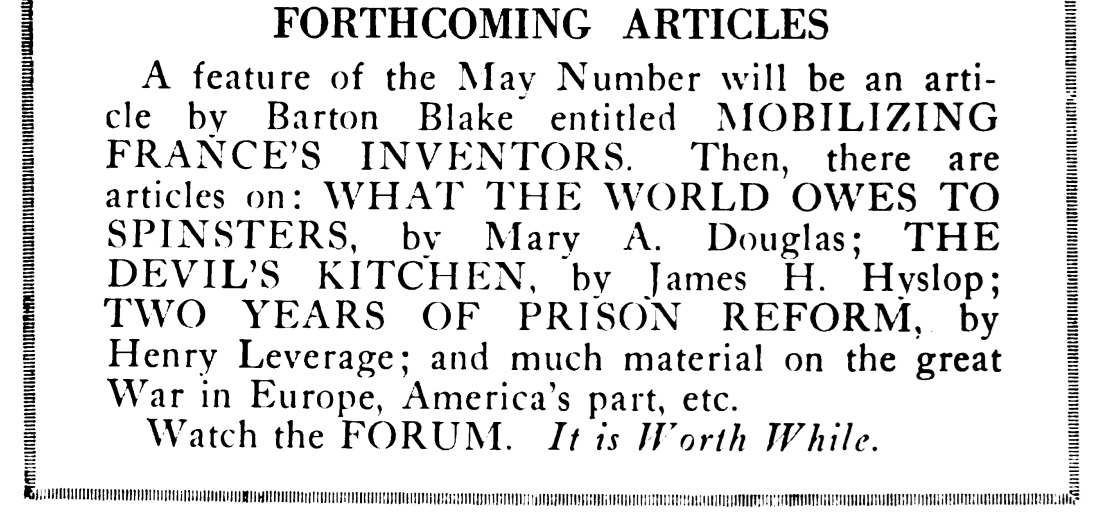
The previous month in The Forum, the following notation concerning "Forthcoming Articles" mentioned this article, as well as an unrelated article by James H. Hyslop, offering yet another clue as to the authorship of "What The World Owes To Spinsters". James Hervey Hyslop, Ph.D., LL.D, (August 18, 1854 – June 17, 1920) was an American psychical researcher, psychologist, and professor of ethics and logic at Columbia University. He was one of the first American psychologists to connect psychology with psychic phenomena.
Gertrude Ogden Tubby was a pioneering figure in the field of psychical research. Born on June 18, 1878, in Kingston, New York, Tubby studied at Smith College and became the special research assistant to James H. Hyslop, the president of the American Society for Psychical Research (ASPR). Her work included investigating a wide range of psychic phenomena such as mediumship, telepathy, clairvoyance, psychokinesis, and survival. After Hyslop's death, Tubby continued to work for the ASPR as a secretary and editor of its Journal until 1924. She also published books like "Psychics and Mediums, A Handbook for Students" and "James H. Hyslop—X, His Book" in 1929, discussing messages she received from Hyslop after his death. Tubby passed away in July 1967.
This is a significant connection. The publication of Mary A. Douglas’s "What the World Owes to Spinsters" alongside an article by James H. Hyslop in The Forum (1917) strengthens the case that Adelaide Branch/Mary Douglas was the author, given her documented ties to psychical research circles—specifically in light of her later association with Gertrude Ogden Tubby, then of Montclair, NJ, Hyslop’s protégé and secretary of the American Society for Psychical Research (ASPR) of which Hyslop was president.
a
Tags
- Log in to post comments