
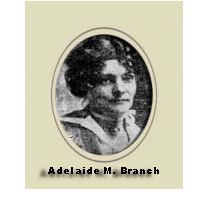
By Tom Rue
Adelaide Mary Branch, later known as Mary Douglas, was born in 1873 into a respected Hartwick family, but refused the genteel life expected of her. After early loss and estrangement, she chose unconventional paths throughout her life — guided by love and moral conviction rather than social conventions or others' approval. As a child, Addie was a devoted and loving daughter whose parents died before she was fully grown, one by suicide and one of cancer. As an adult, she maintained her caretaker, teacher, and healer core values.
An Ohio newspaper quoted her, “As soon as we strip off this little fleshy veil, we are all love for every human soul.” ("Miss Branch Tells Her Story - Heart Mate of Monticello Lawyer Declares She Has No Regrets", Columbus Daily Statesman, December 27, 1913.)
A forthcoming biography reconstructs a well-documented portrait of a woman of independent spirit and deep emotion, who defied the conventions of her era, abandoning a privileged lineage in Hartwick, Otsego County, New York, to live according to her own moral compass. Her choices led her through scandal, devotion, and seclusion, as she sought love, purpose, and dignity in a world where heteronormative society was being challenged by authors and activists like Upton Sinclair, Mary Craig Sinclair, Emma Goldman, Dr. Marie Equi, Agnes and Dr. James Warbasse -- some of whom were at first her rescuers and remained lifelong mentors.
Most of her life, despite being a published author, Adelaide (and later as Mary) kept a relatively low public profile, working with academics and philosophers at Columbia University, Rutgers-Newark, and the American Society for Psychical Research, while supporting herself as an author in her own right. She worked as an "author's assistant" to progressives like the left-leaning president of Dana College, who, and with others of her associates, were accused by the FBI and other three-letter government agencies as communists, socialists, anti-fascists, anarchists, and "dangerous radicals" of the early progressive era.
Her years of voluntary seclusion in Monticello, New York, tending to an aging former county prosecutor named Melvin H. Couch (with whom she told the press she had been in a lasting affair that began in 1898), were the last three years of Couch's life. Caring for him as his health deteriorated, Adelaide chose to live in a closet (a "hidden room", as glamorized by yellow journalists), inside his law office. A prominent attorney and former district attorney, Couch rented office space on the second floor of the Masonic Temple at the center of town, across from the Sullivan County courthouse. Adelaide's private behavior and her public explanations for her life choices blurred the lines between devotion and self-erasure, leaving her both condemned and mythologized by newspapers of the day, and abandoned by her family as a disgraced 40-year-old spinster. Her brother's solution was to institutionalize her, an idea to which she took exception, and she made another plan.
In the second phase of her life, post-Monticello, Adelaide/Mary found friendship and support from fellow travelers whom she met through the Sinclairs, many of whom helped her to make cooperative arrangements with other socialists they knew. Many of these new friends were allies of radicals like Emma Goldman and opposed her deportation after Goldman was convicted in U.S. District Court for the Southern District of New York under the Espionage Act of 1917 for "conspiracy to induce persons not to register" for the draft and "obstructing the recruitment and enlistment service of the United States" during World War I. It presently appears possible that Addie had direct contact with Goldman during the 1930s while working in Newark, New Jersey, for part of what is now Rutgers University, perhaps even helping with Goldman's speaking arrangements.
At the end of her life, which came in 1948, she still lived publicly under her assumed name of “Mary Douglas” (the identity she took for herself after fleeing Monticello in early January 1914). She never married. Her new name embodied not deception nor shame, but rebirth: a woman’s insistence on defining herself, even in a society determined to write her story for her.
In the last years of her life, once again, thanks to the advocacy of her "dangerous radical" friends (as the government labeled them), Mary applied for and was granted monthly stipends to cover her daily expenses by the charitable James N. Jarvie Commonweal Service, a ministry of the Presbyterian Church, although she was not a member of that denomination. (Her own beliefs seem to have leaned more toward Universalism than Calvinism, though when asked, she harkened back to her childhood, calling herself an unchurched Baptist). Under the rules of the JCS, self-referrals were not accepted. People could only be nominated for a pension by a member of the clergy.
On several occasions, the prolific author and social reformer Upton Sinclair explicitly cited "The Story of Adelaide Branch" or "The Heart Wife" to advocate for stronger ethics in journalism, and for the liberalization of divorce laws in New York State. After weaving the true story of Adelaide Branch's life in Monticello and her escape from there after the death of her lover (unpublished manuscript held by the Lilly Library at the University of Indiana), Sinclair declared, "If that be not the raw material of human drama, then I don't know it when I see it!"
Yet, as of now, no academic monographs, journal articles, or histories exist that attempt to treat this woman's life comprehensively and respectfully. Such a biography is now in progress, with information gathered from academic archives, contemporary newspaper accounts, death, census, jail documents, correspondence, mortgages, and other governmental and privately held records.
“My name is Adelaide M. Branch. I was born in Hartwick, near Cooperstown, N.Y., where my brother now is employed in the post office. My father and mother are dead. But that is all I propose to tell of my family history. Their memory is as sacred to me as that of that noble man who was buried today. I will tell all about myself, so far as this case is concerned, but what happened to me before I came to Monticello, fifteen years ago, I feel concerns nobody.” -- Statement of Adelaide Branch to reporters assembled on the court house lawn while detained in the Sullivan County Jail following the sudden death of Melvin Couch, December 1913 |
In 1914, she settled in Manhattan, where, it is said, "her articles appeared in well-known magazines". Adelaide's mind and writings were described by Sinclair as of exceptional quality. Extensive research has yet to locate any surviving writings written by her that bear her byline. Upton Sinclair praised her writing. In 1919, Sinclair shared his first impression of Adelaide after she arrived fresh from her Monticello ordeal at the Sinclair home in Manhattan:
"Yet even in those first hours, one could realize that this woman had a very remarkable mind. She was a woman not merely of refinement, but of really wide culture. She had read great literature and understood it. When she talked about Tolstei's view of sex, or the withering pessimism of Anatole France, you realized that you were talking to an individual personality with an individual point of view. We discovered that during all these years of torment, living the most frightfully tortured life that the imagination could conceive, this man and this woman had been reading such books aloud and discussing them and trying to get some light upon their own tangled fate." -- "The Story of Adelaide Branch", unpublished mss., at the Lilly Library, Indiana University. |
As the saying goes, more will be revealed!
Watch this website as the book develops. Contact here for more information.
Tags
- Log in to post comments