
From Confinement to Commentary: Mary A. Douglas and Reintegration into Progressive Era Reform Discourse
Abstract - In 1913, Adelaide M. Branch entered national headlines amid a controversial confinement proceeding that drew the attention of Upton Sinclair and Dr. J. P. Warbasse. Contemporary press accounts document her transfer to medical supervision through their intervention. By 1917, however, she had reemerged in print culture under the name Mary A. Douglas. Her essay, “What the World Owes to Spinsters,” appeared in The Forum 58, no. 1 (July 1917): 99–113, advancing a sustained defense of unmarried women as economically productive and socially generative actors. Two months later, Forbes, Vol. 1, No. 2 (September 29, 1917), attributed to her the statement, “Women are vital forces giving their vitality to an anemic world.” The appearance of her language in both a national literary review and an early issue of a business periodical indicates circulation across reform and economic journalism during wartime mobilization. While no archival evidence yet demonstrates direct editorial sponsorship by Sinclair or Warbasse, Douglas’s documented connections to their reform networks complicate interpretations of her as merely a subject of intervention. Instead, the evidentiary record supports her repositioning as a published contributor to Progressive era debates over gender, labor, and social vitality. This case invites reconsideration of how women publicly stigmatized through medical or legal processes could reenter intellectual life and reshape reform discourse.
Writings of Mary A. Douglas that have been located...
WHAT THE WORLD OWES TO SPINSTERS
MARY A. DOUGLAS
[formerly also known as Adelaide M. Branch]
Published in The Forum, July 1917, pp.99–1143
Pull-quote: "Women are vital forces giving their vitality to an anemic world.' -- Mary A. Douglas" (in Forbes Magazine, Vol. 1, No. 2, September 29, 1917, p. 84.
THE HOUSE OF ONE ROOM
MARY A. DOUGLAS
[formerly known as Adelaide M. Branch]
Published in Book News Monthly, September 1916, pp. 13–14
POEMS BY ADELAIDE M. BRANCH
Published in The New York World, December 24, 1913, p. 2
While Adelaide sat confined in the Sullivan County Jail, a senior member of the Sheriff's staff doled out her personal papers gathered from Couch’s office to inquiring reporters gathered on the courthouse lawn, including poems published by the New York World (Joseph Pulitzer’s flagship paper), with no payment for the stolen material. The news account began:
"Among the documents found in the inner room, of which for three years out of fifteen the Branch woman had been an absolute prisoner, were some copies of verses she had written to while away the solitary hours she passed there. Two of them were given to an Evening World reporter by Under Sheriff Hall. One read as follows:
"ALONE"
Like a prisoner of hope,
On an isle of despair,
I am sitting and watching
The happy and fair.
As they pass in the street
How little they dream
Of the woman who's sitting
And watching them here,
But a captive of love
Is a willing bond slave,
And her happiness lies
In the touch of a hand,
As the ocean rejoices
And sings in its waves
When the surge caresses
The soft yielding hand.
“The other poem given out is called:
"IT MIGHT HAVE BEEN"
Youth, hopes have fled;
And like the dead
Sad, withered leaves fall.
I muse at evening-tide upon
The sorrow of it all.
It might have been, yes, might have been.
The life I held in thrall
Was cast away one summer's day,
My heart is in its fall."
[1] "'Soul Widow' Will Go To Her Relatives From Prison Cell - Kin of Miss Branch, Who Was the Secret Affinity of Lawyer Couch, Wire Sheriff They Will Welcome Woman Now in Jail - Tried to Kill Herself When Raving for 'Mel' - Brother-in-Law of Couch Tells of Vain Effort to Hid Woman and Avoid Scandal After His Death", The Evening World (New York), December 24, 1913, pp. 1-2.
Writings yet to be located...
These are a few essays that have been identified in secondary sources, full texts of which are yet to be located for verification:
Mary A. Douglas, "A Sacrifice to the Gods", Young’s Magazine, November 1915. Her byline appears alongside notable writers of the era, including Louise Winter who wrote the featured novelette The Year of Unrest, Alicia Ramsey, and James Mortimer. Published at 13 West 20th Street, New York. (Advertised in the Democrat and Chronicle, November 12, 1915, p. 17.)
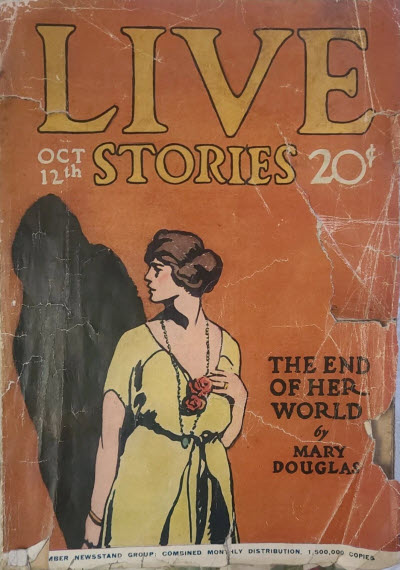
Mary A. Douglas, “The End of Her World,” Live Stories, Vol. XXXX No. 3, October 12, 1923, p. 8. Published by New Fiction Publishing Co., 20¢, pulp, cover by C.B. Falls. (See cover image below.)
The Documentary Record
I. From Scandal Subject to Reform Network Dependent
Recent recovery of Mary A. Douglas’s mid-1910s publications complicates prevailing narratives that treat Adelaide M. Branch primarily as a subject of medical confinement and reform intervention. While contemporary press coverage in 1913 positioned her as a figure of scandal and psychiatric controversy, by mid 1917 she had reemerged in national print culture under the name Mary A. Douglas. Her essay, “What the World Owes to Spinsters,” published in The Forum 58, no. 1 (July 1917): 99–113, advanced a structured defense of unmarried women as socially and economically generative actors. Two months later, Forbes, Vol. 1, No. 2 (September 29, 1917), 84, attributed to her the statement from the essay: “Women are vital forces giving their vitality to an anemic world.” The placement of her language in an early issue of a national business periodical indicates that her arguments circulated beyond literary reform venues into emergent business journalism during wartime mobilization.
Although no documentary evidence yet demonstrates direct editorial sponsorship by Upton Sinclair or J. P. Warbasse, contemporary reporting confirms that both men intervened in her 1913 confinement case. The 1917 publications, therefore, mark not merely personal rehabilitation but reentry into Progressive era discourse as a published commentator on gender and economic life. Douglas should be reconsidered not only as a subject within reform networks, but as a contributor to their intellectual production.
II. Network Matrix: Confirmed vs. Probable Associations
The following matrix distinguishes documented relationships from interpretive inferences. Only relationships supported by primary documentation are classified as confirmed.
| Individual / Institution | Nature of Relationship | Status | Evidence |
|---|---|---|---|
| Upton Sinclair | Intervened in 1913 confinement case | Confirmed | New York Times, January 3, 1914 reporting Warbasse involvement through Sinclair |
| Dr. J. P. Warbasse | Medical oversight in 1913 transfer to sanitarium | Confirmed | Contemporary press reports January 1914 |
| Agnes Warbasse | Correspondence discussing Branch | Confirmed (as correspondent in Sinclair circle) | Referenced in Sinclair manuscripts, Lilly Library |
| Mary Craig Sinclair | Discussed Branch in correspondence | Confirmed (correspondence exists) | Lilly Library Sinclair manuscripts |
| Gertrude Ogden Tubby | Listed as reference in 1942 Jarvie Service case file | Confirmed | 1942 Jarvie Service case record signed by Mary Douglas |
| Dr. Edward H. Zabriskie | Reference in 1942 Jarvie file; personal interview noted | Confirmed | 1942 Jarvie Service case record |
| Prof. Walter Rautenstrauch | Reference in 1942 Jarvie file | Confirmed | 1942 Jarvie Service case record |
| The Forum | Published essay July 1917 | Confirmed | The Forum 58, no. 1 (July 1917) |
| Forbes Magazine | Printed attributed quotation September 29, 1917 | Confirmed | Forbes Vol. 1, No. 2, p. 84 |
| American Union Against Militarism | Organizational overlap with Warbasse circle | Probable indirect exposure | Warbasse documented involvement; no record yet of Douglas membership |
| Woman’s Peace Party / WILPF | Ideological alignment with 1917 essay themes | Speculative | No membership documentation located |
| Columbia University intellectual circle | Professional proximity via references and later employment | Confirmed contact; scope unknown | 1942 Jarvie file references |
This matrix reflects current documentary limits. Expansion requires archival verification of manuscript collections.
II. The Warbasse Household and Progressive Medical Reform
Dr. James Peter Warbasse was a Brooklyn surgeon and prominent advocate of cooperative medicine and socialized health principles. He later became a key figure in the cooperative movement and authored The Cooperative Way (1927). His wife, Agnes Warbasse, was active in reformist and literary circles.
Contemporary reporting confirms that Branch was placed under Warbasse’s supervision in early 1914.² Archival correspondence cited further indicates that Agnes Warbasse maintained evaluative commentary on Branch’s psychological state during this period, and that she visited Branch more than once during her inpatient period in a sanitarium in Amityville, New York in 1914.
Although the full correspondence requires independent archival review, the broader context is secure: Branch’s transition to the identity “Mary A. Douglas” occurred while she was embedded within a network that combined:
- Socialist reform (Sinclair)
- Cooperative medical reform (Warbasse)
- Progressive intellectual culture (Brooklyn and Manhattan circles)
Her later writings must be interpreted against that milieu.
III. Adoption of the Name Mary A. Douglas and Entry into Print Culture
By November 1915, Mary A. Douglas is documented as contributing “A Sacrifice to the Gods” to Young’s Magazine, a New York periodical. This attribution is supported by contemporary advertisements, though the text has not yet been examined.
If confirmed, this would indicate that within approximately two years of the 1913 scandal, Branch had reentered public discourse under a new name and in a voluntary authorial capacity.
By September 1916, “The House of One Room” was reportedly published in Book News Monthly. This venue suggests a readership interested in literary and cultural commentary rather than sensational journalism.
The decisive documentary milestone occurs in July 1917, when Mary A. Douglas published “What the World Owes to Spinsters” in The Forum, a nationally respected monthly.³
This publication places Douglas within a mainstream reform discourse. The Forum regularly featured commentary on politics, social reform, and modern intellectual trends. Her essay argues for recognition of unmarried women’s social contributions, critiquing patriarchal assumptions about dependency and usefulness.
The thematic alignment with Sinclair and Warbasse circles is notable:
- Emphasis on women’s economic independence
- Critique of traditional marriage norms
- Assertion of female intellectual agency
While no direct documentary evidence proves that Sinclair or the Warbasses arranged the editorial placement, Douglas’s access to such a venue is consistent with her proximity to established reformers who were themselves experienced in national periodical publishing. This observation is inferential but contextually grounded.
IV. Ideological Convergence with Sinclair
Upton Sinclair’s The Brass Check (1919) attacked yellow journalism and the press's exploitation of vulnerable individuals. Sinclair had firsthand exposure to the Branch scandal and its sensational coverage. The December 1913 publication of her poems without compensation illustrates precisely the type of journalistic practice Sinclair condemned.
Douglas’s 1917 essay does not reference the scandal directly. However, its insistence on recognizing women’s unpaid labor and moral seriousness resonates with the broader Progressive critique of social hypocrisy articulated by Sinclair.
The convergence is ideological rather than explicitly collaborative. The record does not presently demonstrate co-authorship, editorial sponsorship, or documented correspondence about her publications.
V. Publications
Verified Publications of Adelaide M. Branch / Mary A. Douglas
1. Branch, Adelaide M.
“ALONE.”
The Evening World (New York), December 24, 1913.
“IT MIGHT HAVE BEEN.”
The Evening World (New York), December 24, 1913.
Context: Poems printed in connection with newspaper coverage of confinement proceedings.
Status: Verified via newspaper archive.
2. Douglas, Mary A.
“What the World Owes to Spinsters.”
The Forum 58, no. 1 (July 1917): 99–114.
Genre: Essay.
Subject: Economic and moral defense of unmarried women.
Status: Verified via periodical archive.
3. Douglas, Mary A.
“Women are vital forces giving their vitality to an anemic world.”
Forbes 1, no. 2 (September 29, 1917): 84.
Genre: Attributed quotation (pull-quote).
Context: Early issue of a national business periodical.
Status: Verified via Internet Archive scan.
Unverified but Reported Materials
- Alleged unpublished autobiographical manuscripts written during 1914 sanitarium confinement.
Status: Referenced in correspondence within Sinclair/Warbasse papers; manuscripts not located. - Possible editorial or ghostwriting work in academic or government publications (1920s to 1940s).
Status: Occupational census designations suggest authorship activity; no signed publications identified.
Archival Repositories for Further Investigation
- Lilly Library, Indiana University – Upton Sinclair manuscripts.
- Presbyterian Historical Society – Jarvie Service case files.
- Columbia University Archives – Rautenstrauch papers (potential professional correspondence).
- Dana College related archives – Edward H. Zabriskie materials.
- Hartwick/Otsego Historical archives – girlhood/schooling sites and materials.
Conclusion
On present evidence, Mary A. Douglas:
- 1913: Literary voice exposed involuntarily through scandal journalism.
- Circulated within documented Sinclair and Warbasse reform networks.
- Reestablished a public intellectual presence after the 1913 confinement episode.
- 1914: Rescue and medical placement through Sinclair Warbasse connections.
- 1915 to 1917: Emergence as a bylined author under a new identity as a nationally published essayist.
Her case illustrates how reform circles could function not only as ideological communities but as mechanisms of reputational reconstruction. The documentary evidence establishes her presence within that milieu. Further archival research, particularly in Sinclair and Warbasse correspondence, may clarify the extent of her integration into their intellectual networks.
Her role within Progressive reform discourse should be classified as:
Documented participant with verified publication record.
Further claims regarding organizational leadership or sustained editorial sponsorship remain unproven.
Sources Cited
- “‘Soul Widow’ Will Go To Her Relatives From Prison Cell…,” The Evening World (New York), December 24, 1913, pp. 1–2.
- “Give Aid To Miss Branch -- New Found Friends Provide Refuge In Long Island Sanitarium,” The New York Times, January 3, 1914.
- Douglas, Mary A., “What the World Owes to Spinsters,” The Forum 58, no. 1 (July 1917): 99–114.
Addendum, 2/27/2026:
From The FictionMags Index - by Name: Page 933
Douglas, Mary A. (fl. 1910s-1940s) (chron.)
- * Another Girl’s Man, (ss) Sweetheart Stories #5, January 20 1926
- * The Awakening of Mr. Perkins, (ss) Snappy Stories 1st July 1919
- * Bread and Cheese and Kisses, (ss) All-Story Love Stories February 2 1935
- * The End of Her World, (ss) Live Stories October 12 1923
- * Fireflies, (ss) Snappy Stories 1st May 1918
- * Half an Hour Too Late, (ss) All-Story December 15 1931
- * The Hidden Heart, (ss) Cupid’s Diary April 7 1926
- * House of Mystery, (nv) Love Story Magazine April 14 1923
- * The Husks of Life, (sl) Love Story Magazine Jul 25, Aug 10, Aug 25, Sep 2, Sep 9 1922
- * I Have Made My Dreams Come True, (ts) National Brain Power February 1923
- * The Last Kiss, (ss) Love Romances August 1929
- * Left Out of Love, (ss) Sweetheart Stories #3, December 23 1925
- * Love Is Cruel, (ss) All-Story Love Tales April 16 1938
- * Love Just Happens, (ss) Love Romances March 1931
- * Lovers, Pretend!, (ss) All-Story Love Stories June 23 1934
- * The Madness of Youth, (ss) Sweetheart Stories #6, February 3 1926
- * A Pair of Blue Eyes, (ss) All-Story Love Stories August 18 1934
- * Romance Behind the Clouds, (ss) Sweetheart Stories #2, December 9 1925
- * Sideshow, (ss) Australian Cavalcade November 1946
- * A Silent Altar, (ss) All-Story October 4 1930
- * Sunlight and Moonlight, (ss) Young’s Magazine November 1915
- * Two Is Company, (ss) All-Story Love Stories May 25 1935
- * Underneath the Honey Moon, (ss) Sweetheart Stories #4, January 6 1926
- * A Week Before the Wedding, (ss) All-Story Love Stories August 31 1935
- * When Dreams Come True, (sl) Cupid’s Diary Oct 21, Nov 4, Nov 18, Dec 2 1925
- * The White Flower, (ss) Cupid’s Diary February 13 1924
- * You Never Know ’Til You’re Married, (ss) All-Story Love Tales March 5 1938
- * Youth Finds the Way, (ss) Sweetheart Stories #1, November 25 1925
Dramatic Novels [v1 #1, No. 1, May 1924] (Albert Publishing Co., 15¢, 128pp) []
Details supplied by David Lee Smith.
- 3 · Love Knows No Law · Duchess de la Mare · na
- 107 · The White Flower · Mary Douglas · ss Cupid’s Diary February 13 1924
- 113 · The Beautiful Brute (An Elevator Girl Confesses) · [uncredited] · ss
Pulp magazines such as the above were inexpensive, mass‑market fiction magazines printed on cheap wood‑pulp paper and sold from the late 1890s through roughly the 1950s. They prioritized fast, entertaining fiction across many genres and were physically larger and cheaper than the higher‑quality “slick” magazines.
NOTE: In the context of the biography that I am currently writing of Mary A. Douglas, I am seeking to document her literary contributions and to reconstruct her professional network within early twentieth century reform and publishing circles. Today, I discovered a compiled bibliography of Douglas's known and attributed periodical publications appears here on philsp.com. Authorship of these latest titles is being confirmed. I plan to have "The Hidden Woman: The True Story of Adelaide Branch", published and released by the end of 2026. Watch this website for developments. --T.R.
Tags
- Log in to post comments