Daniel Skinner Sr.: "Lord High Admiral" of the Delaware
Daniel Skinner Sr., historically celebrated as the "Lord High Admiral" of the Delaware River, "Skinners Falls" as his namesake, was born in the town of Preston, New London County, Connecticut, and baptized on May 13, 1733.1 He was the son of Joseph Skinner Sr. and Martha Kinne, who married on April 30, 1729.2 Daniel grew up in a large household alongside his siblings: Benjamin, Timothy, Abner, Haga (also spelled Haggai, Hagga, or Haggia), Calvin, Joseph, Martha, and Huldah.3
The Move to Cushetunk and Family Tragedy
In 1755, the newly organized Connecticut-backed Delaware Company began securing and colonizing land tracts taken from the Delaware (Lenape) Indians.4 Joseph Skinner Sr. was among the listed grantees, and by 1757, he migrated with his family and other pioneers to a prominent river flat on the west side of the Delaware River, just below the mouth of the Callicoon Creek.5 This frontier settlement, located in the remote wilderness of Cushetunk, was known as the Ackhake Place or St. Tammany's Flats.6 The latter name arose from a persistent local tradition that the famous Delaware Chief Tamanend (Tammany) had once pitched his wigwam under a great elm tree on those flats.7
The family's pioneering endeavors were soon shattered by tragedy. Around 1758 or 1759, Joseph Skinner Sr. journeyed away from home on business regarding the family's land titles and vanished.8 Roughly two years later, his skeletal remains were discovered in a nearby brook; he had been shot and killed, though his murderers were never identified.9 He was identified primarily by a prayer book found in his pocket containing his name.10 While Daniel's mother and sisters returned to Connecticut following this tragedy, Daniel and his brothers chose to remain in the valley to clear the wilderness and secure their claims.11
Seafaring, Land Titles, and Marriage
In his youth, Daniel Skinner left the valley for a time to work as a sailor.12 During his travels, he continued to invest in the region, purchasing a half-right in the Susquehanna Company in 1758 and a half-share in the Delaware Company in 1760 while temporarily residing in Newtown, Sussex County, New Jersey.13 In 1761, he married a widow named Richardson, who had a fourteen-year-old daughter named Phoebe.14 By 1763, Daniel had returned permanently to the St. Tammany homestead to farm.15
(Note: While some accounts of local hostilities in the autumn of 1763 describe family members harvesting buckwheat being ambushed at Calkins Creek, these records actually pertain to the family of fellow pioneer Jedediah Willis, who lost his life in that engagement alongside Moses Thomas Sr.)16
The "Lord High Admiral" of the Delaware
Following the end of hostilities, Skinner returned to his farming and lumbering pursuits at St. Tammany's Flats.17 Seeing the massive, straight white pines towering along the riverbanks, he envisioned a lucrative business selling them to Philadelphia shipyards to be used as ship masts.18
- The 1763 Failure: His first attempt in 1763 failed when he tried to float loose, unfastened logs down the river while guiding them from a canoe, losing the entire batch.19
- The 1764 Success: The following year, 1764, Skinner pioneered a revolutionary technique.20 He put six of his largest logs into the water, mortised the ends, and pinned them together using a white oak spindle to form a sturdy, unified raft.21 Rigging steering oars fore and aft, Skinner and a Dutchman boldly piloted the craft through the river's treacherous rifts, delivering it safely to Philadelphia.22
This historic run birthed the Delaware rafting industry.23 By general acclaim, Skinner was crowned the "Lord High Admiral of all the raftsmen on the Delaware," and his frequent, boisterous rafting partner, Josiah Parks, was dubbed the "Boatswain" ("Old Boson").24 Under the unwritten laws of the river, no man could legally steer a raft to market without the Admiral’s personal consent, which was traditionally secured by presenting him with a bottle of wine to run as a "fore-hand" and another bottle to graduate to "steersman".25
Pennsylvania Patents and the Christmas Day Scuffle
To solidify his land holdings against competing provincial claims, Skinner purchased rights in the Philadelphia Land Office, ultimately securing a formal patent from Thomas and John Penn on May 3, 1775.26
However, local friction with competing claimants persisted. On Christmas Day in 1771, a scuffle broke out at Nicholas Conklin’s tavern in Cushetunk.27 Daniel and his brother Haggai were accused by a malicious neighbor named Nathaniel Evans of "beating and wounding several Indian Chiefs" of the Oneida, Tuscarora, and Mohican tribes, which triggered a high-level arrest warrant from the Governor of Pennsylvania in May 1772.28 Fortunately, Nicholas Conklin, William Conklin, and other settlers signed sworn affidavits proving that the Native Americans had become highly intoxicated, initiated the fight after being denied rum, and that Daniel was an honest, peaceable man who had already settled the matter amicably with the Indians the previous winter.29 The charges were subsequently dropped.30
Freemasonry and the Newburgh Marriage
Skinner was a central figure in bringing Freemasonry to the Delaware Valley. In 1800, a warrant was granted to hold meetings at his log house on St. Tammany’s Flats, establishing St. Tammany's Lodge, No. 83.31 His sons, Reuben and Nathan, were instrumental in its operation.32 The lodge room occupied the building’s second story, accessible only by a ladder that was hauled up once the members gathered to prevent intruders.33
In his advanced years, having become a widower, Skinner married a woman named Rosabella from Newburgh, New York.34 This late-life romance was immortalized by a local poet named Seeley.35 The poem depicted the Admiral standing on the hills east of the Delaware, pointing out his beautiful valley home to his new bride:
"Behold St. Tammany! Behold the fountains!
At the foot of the hill,
There is a saw-mill,
And plenty of timber on the mountains."35
The Revolutionary War and Later Years
During the Revolutionary War, the Skinner family attempted to remain neutral, but their neutrality did not protect their property.36 Daniel Skinner’s house was burned to the ground, and he was obliged to escape to the deep woods to survive.36
Daniel Skinner Sr. passed away in early 1813.37 He was laid to rest beside his first wife on a beautiful knoll on St. Tammany's Flats, overlooking the Delaware River that he had navigated so successfully.37
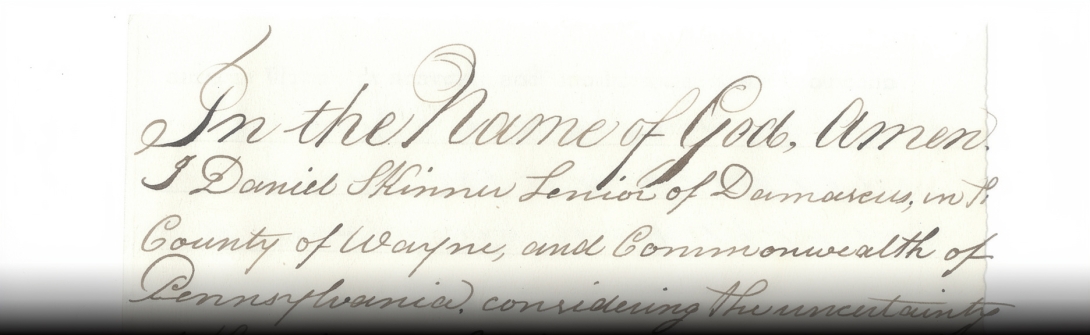
He executed his Last Will and Testament on February 23, 1813, which was officially probated in Wayne County on March 1, 1813.38 His final wishes and distribution of his extensive estate included:39
- To his wife, Rosabella: His dwelling house and lot in the village of Newburgh on Ann Street, Orange County, New York (on the condition she accept it in place of her dower), as well as all the money in his possession at his death. (If she refused, the Newburgh house was to go to Sarah and Susannah, daughters of his deceased son Joseph).
- To his son Daniel Skinner Jr.: 200 acres of land out of his current holdings, and all of his wearing apparel.
- To his son William H. Skinner: A note of hand for about $300, on the condition that William pay $200 to Daniel’s daughter, Sarah Conklin (wife of John Conklin).
- To his son Nathan Skinner: 100 acres of land, 50 acres back of the sawmill (including the pond), and all of his books.
- To his daughters, Lilly Land (wife of John Land) and Sarah Conklin: All the household furniture that belonged to his first wife, to be divided equally.
- To his daughter Mary Wilcox: One turnpike share of Great Bend & Cochecton Turnpike Stock.
- To his grandson Daniel K. Skinner (son of Joseph, deceased): His mansion house, contiguous flat lands, and 200 acres back on the hill, to be rented out by executors for his benefit until he reached twenty-one years of age.
- To his grandson Albo Skinner (son of Nathan): A barn and lot on Ann Street in Newburgh.
- To his grandson Cortland Skinner: The residue of the lot from which Nathan received 100 acres.
- To Ira Skinner and James Smith: The residue of the lot given to his son Daniel Jr.
He appointed his wife, Rosabella, and his son, Nathan Skinner, as the executors of his estate, witnessed by Freeman Allen, James Luty, and John Seaman.40
- Log in to post comments