
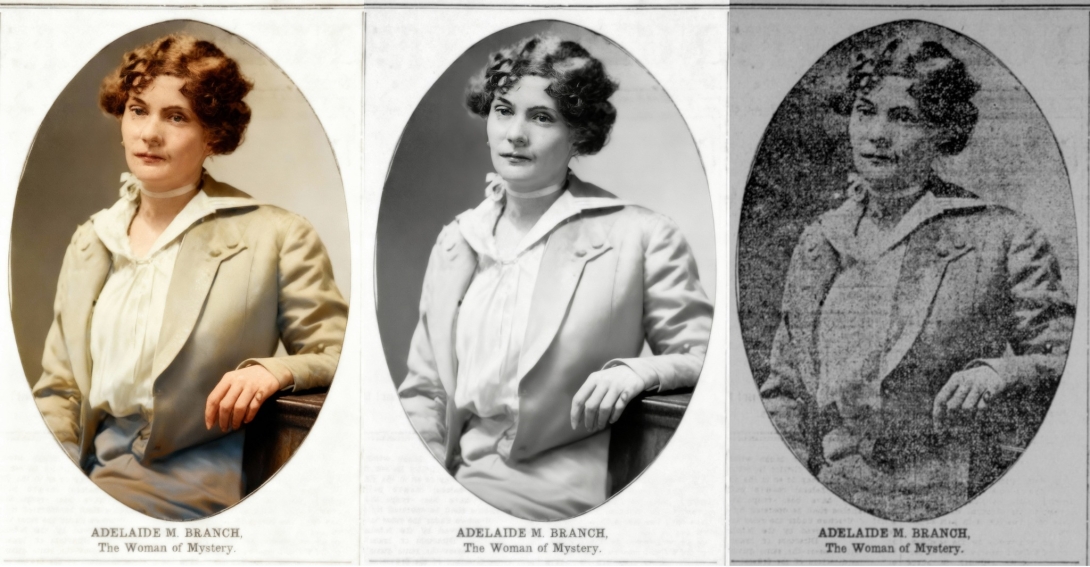
I. The Pre-Dawn Getaway and Identity Shift (December 28, 1913)
Under cover of darkness at 5:00 AM on Sunday, December 28, 1913, Sheriff Frank Kinnie and former Sheriff David Avery smuggled Adelaide Mary Branch out the rear entrance of the Sullivan County Jail at 2 Bushnell Avenue. Placed into a high-powered, sixty-horsepower luxury automobile, she was driven at top speed along the unpaved turnpike to the South Fallsburg O&W station, successfully bypassing the hounding Hearst and Pulitzer reporters camped at the Monticello depot.
Boarding the 6:00 AM train to Manhattan, Adelaide permanently discarded her disgraced birth name, "Adelaide M. Branch," and re-entered public life under her reclaimed identity, Mary A. Douglas (1873–1948). Crucially, "Mary A." was not a random pseudonym; genealogical records reveal that as a one-year-old infant in the 1875 New York State Census, she had been enumerated as "Mary A. Branch," making her name change a profound reclaiming of her earliest origin prior to family trauma and sequestration.
II. Morningside Heights and Academic Autonomy in Manhattan
Arriving in New York City under the care of progressive author Upton Sinclair and Dr. James Peter Warbasse, Mary Douglas underwent a structured rest cure at Dr. Warbasse's Amityville sanitarium. By late 1914, having fully recovered her physical and psychological strength, she established an independent residence in the Morningside Heights neighborhood of Manhattan, near Columbia University.
Over the next three decades, Mary Douglas built a highly respected career as an independent research contractor, manuscript editor, and indexer for leading Columbia intellectuals and research organizations:
- Prof. Henry Zabriskie: Provided specialized scholarly research and editorial index work.
- Prof. Walter Rautenstrauch: Served as research assistant and typist for Rautenstrauch, a prominent professor of industrial engineering at Columbia University and founder of Technocracy Incorporated.
- Gertrude Ogden Tubby: Contracted as research assistant for Tubby, the noted author and longtime secretary of the American Society for Psychical Research (ASPR).
- Washington, D.C., and Census Records: As documented in the 1940 U.S. Federal Census and Jarvie Commonweal records, Mary Douglas resided temporarily in Washington, D.C., working on federal research projects before returning to Morningside Heights.
III. The 1917 Feminist Manifesto: "What the World Owes to Spinsters"
In July 1917, writing as Mary A. Douglas, she published a landmark fifteen-page essay in Mitchell Kennerley's prestigious literary monthly, The Forum (Vol. 58, pp. 99–113), titled "What the World Owes to Spinsters."
Drawing directly from her lived experience of fifteen years of unacknowledged labor behind Melvin Couch's partition wall, Douglas delivered a biting Progressive Era feminist critique of patriarchal marriage and unpaid domestic servitude:
- "Intensive" vs. "Extensive" Labor: Douglas argued that marriage forced a woman into intensive labor—orbiting exclusively around the personal comfort and career of a single man. In contrast, the single woman ("spinster") engaged in extensive labor, directing her intellect, professional skills, and empathy outward to reform society.
- Reclaiming Single Womanhood: Inverting Victorian stigmas of the "fallen woman" or deficient spinster, Douglas asserted that unmarried women constituted the primary engine of educational, literary, and social progress in modern civilization.
IV. Archival Recovery: The Jarvie Commonweal Case Files and Kensico Burial
For decades, regional historians assumed Adelaide Branch had died in obscurity or committed suicide shortly after the 1913 scandal. The definitive archival breakthrough occurred through biographer Tom Rue's location of her 1948 New York City death certificate, which identified the Jarvie Commonweal Service as the official informant.
The subsequent release of the Jarvie Commonweal Service case records (administered under the Presbyterian Board of National Missions) confirmed her thirty-four-year career as Mary A. Douglas, documenting her financial independence, her academic client roster, and her quiet passing on July 24, 1948, at age 75. She was buried in a quiet plot at Kensico Cemetery in Valhalla, Westchester County, New York—completing one of the most remarkable journeys of sequestration, reclamation, and intellectual rebirth in American history.
V. Chronological Rebirth Matrix (1873–1948)
| Year / Period | Name & Identity | Historical Location & Milestone |
|---|---|---|
| 1873–1880 | Mary A. Branch | Enumerated as "Mary A." at age 1 in 1875 NY Census, Otsego County, NY. |
| 1898–1913 | Adelaide M. Branch | Living in Monticello, NY; 3-year office partition sequestration in Room No. 3. |
| Dec 28, 1913 | Identity Shift | Pre-dawn getaway to South Fallsburg; discards birth name, becomes Mary A. Douglas. |
| 1914–1940s | Mary A. Douglas | Resides in Morningside Heights, NYC; academic research contractor for Columbia faculty. |
| July 1917 | Mary A. Douglas | Publishes "What the World Owes to Spinsters" in The Forum (Vol. 58). |
| 1940 | Mary Douglas | Enumerated in 1940 Census in Washington, D.C., working as an independent researcher. |
| July 24, 1948 | Mary A. Douglas | Passes away at age 75; Jarvie Commonweal informant; buried at Kensico Cemetery. |
- Log in to post comments